
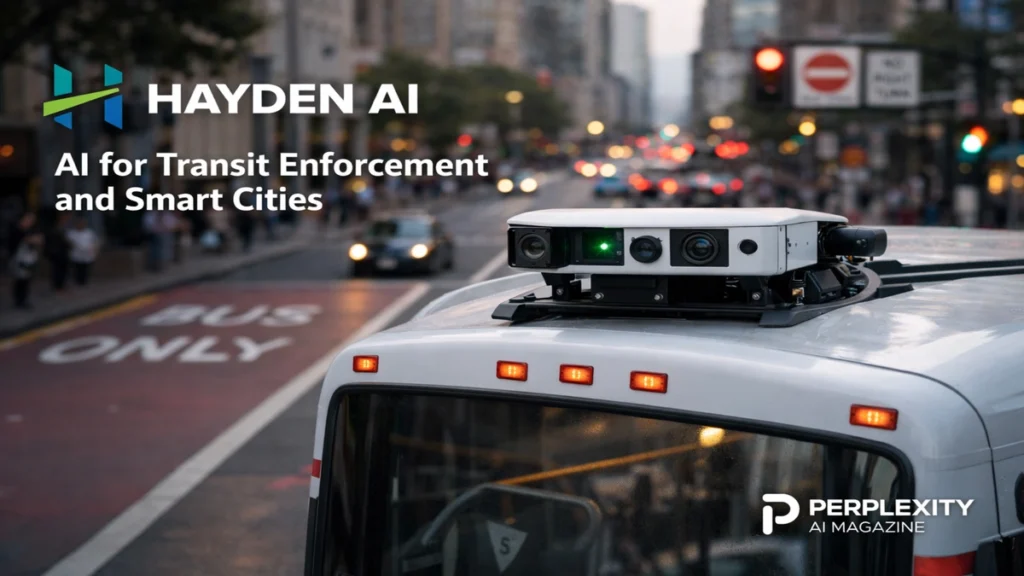
I first noticed Hayden AI not through a press release or a flashy demo, but through a statistic buried in a transit briefing: bus speeds had quietly improved without adding lanes, drivers, or schedules. That detail led me to a San Francisco startup that has built its entire philosophy around a simple premise. If cities want faster, safer transit, enforcement has to move with traffic, not sit above it.
Founded in 2019, Hayden AI develops AI-powered computer vision systems mounted directly on public transit vehicles. These systems detect traffic violations like illegal parking in bus lanes and bus stops, process the data on the vehicle itself, and produce enforcement-ready insights without human review. The approach challenges traditional models of traffic enforcement that depend on fixed cameras, manual ticketing, or reactive policing.
Within the first moments of understanding the system, the appeal becomes obvious. Cities already operate large fleets of buses that traverse nearly every major corridor, every day, at every hour. Hayden AI turns those fleets into mobile perception platforms, creating real-time digital representations of urban movement. Instead of watching streets from poles or rooftops, the city sees itself from the perspective of public transit.
This article examines how Hayden AI’s technology works, why transit agencies are adopting it, how it compares with other smart city platforms, and what its rise says about the future of automated enforcement. It also looks closely at the company’s founder, its funding trajectory, and the broader policy implications of delegating enforcement to algorithms that operate at street level.
The Urban Problem Hayden AI Set Out to Solve
Urban traffic enforcement has long suffered from a mismatch between rules and reality. Bus lanes exist on paper, but drivers block them. Bike lanes are painted, but deliveries spill into them. Cities write citations, but enforcement coverage is inconsistent and politically sensitive. The result is predictable: slower buses, frustrated riders, and rising safety risks.
Hayden AI approached the problem from a transit-first perspective. If buses are delayed by violations, then enforcement should be embedded in the buses themselves. This framing shifts enforcement away from punishment and toward system performance. The goal is not simply issuing tickets but restoring the intended function of transit infrastructure.
By automating detection and evidence capture, the platform reduces reliance on human observation. Transit agencies receive consistent data across routes and times, allowing them to identify chronic problem areas rather than isolated incidents. Over time, this consistency changes behavior, not just outcomes.
Urban planners increasingly view enforcement data as a planning signal. When violations cluster in specific locations, it often reflects design failures rather than individual misconduct. Hayden AI’s data feeds that insight back into planning decisions.
Read: Tempus’s AI Voice Assistant: How Tempus One Helps Oncologists
Core Technology and System Architecture
At the heart of Hayden AI’s platform is edge-based computer vision. Cameras, GPS modules, and inertial sensors are mounted on buses and other municipal vehicles. As the vehicle moves through the city, the system continuously analyzes its surroundings.
Crucially, processing happens on the device. The AI models identify lane markings, signage, vehicles, and spatial context in real time. When a violation is detected, the system records the event, associates it with location and time data, and prepares it for enforcement workflows. Raw video does not leave the vehicle.
This architecture reflects a deliberate design choice. By avoiding cloud-based video processing, Hayden AI minimizes privacy risk and reduces latency. It also sidesteps the political backlash often associated with centralized surveillance systems. From a technical standpoint, it demands highly optimized models capable of running reliably in harsh, variable environments.
The same data that supports enforcement also enables digital twin modeling. Over time, fleets generate detailed representations of how streets function under real conditions. These models inform decisions about signal timing, curb management, and street redesign.
Key Applications in Transit and Safety
The most visible application of Hayden AI’s technology is bus lane enforcement. Cities deploying the system report measurable improvements in transit speed and reliability. When bus lanes are consistently cleared, schedules stabilize and rider confidence improves.
Beyond enforcement, the platform supports safety analytics. By observing pedestrian behavior, vehicle interactions, and congestion patterns, agencies gain insight into where conflicts occur most frequently. This information supports targeted interventions, from signage changes to physical redesigns.
The system is also expanding beyond buses. Parking enforcement vehicles, municipal fleets, and other mobile assets can host the same perception technology. This expansion reflects a broader vision of mobile urban sensing rather than single-use enforcement tools.
Growth, Funding, and Institutional Adoption
Hayden AI’s growth has tracked closely with rising investment in smart city infrastructure. In 2024, the company closed a $90 million Series C round led by a major impact-focused investment fund. That capital followed earlier seed and Series A rounds that financed initial deployments and model development.
In total, the company has raised more than $130 million across multiple funding stages. The funds have supported expansion into major transit agencies, continued research in computer vision, and scaling of operational support.
Transit authorities adopt the platform not as an experimental pilot but as a production system integrated into existing enforcement frameworks. That distinction matters. It signals institutional confidence in both the technology and its legal defensibility.
Founder Background and Leadership Influence
The company’s trajectory is inseparable from its founder, Chris Carson. A U.S. Marine Corps veteran, Carson brought a systems-level perspective shaped by military exposure to autonomous defense technologies. His academic background includes advanced study in computer vision and simultaneous localization and mapping.
Carson co-founded Hayden AI after observing persistent bus lane violations while riding public transit in San Francisco. The idea was not theoretical. It emerged from direct observation of a daily inefficiency that technology could plausibly address.
Under his leadership, the company prioritized patents, privacy-first design, and close collaboration with public agencies. That approach positioned Hayden AI less as a consumer technology firm and more as an infrastructure partner. Carson stepped down from the CEO role in late 2024 to pursue a new venture, but the technical and organizational foundation he built continues to define the company.
Competitive Landscape and Differentiation
Hayden AI operates within a crowded smart city ecosystem, but its focus is unusually narrow. While competitors often pursue broad urban analytics using fixed cameras or generalized IoT networks, Hayden AI specializes in mobile, transit-integrated enforcement.
This specialization produces clear differentiation. Fixed systems capture static views. Hayden’s systems capture the city as it moves. That mobility enables richer contextual understanding, particularly for violations that disrupt transit flow rather than general traffic.
Some platforms focus on environmental monitoring or passenger analytics at stops. These tools can complement Hayden AI’s system, but they do not replace its core function. The company’s strength lies in turning enforcement from an episodic activity into a continuous operational layer.
Comparative Overview of Smart City Platforms
| Platform Type | Primary Focus | Structural Limitation |
|---|---|---|
| Fixed traffic cameras | Intersection monitoring | Limited spatial coverage |
| General IoT networks | Broad urban metrics | Weak enforcement integration |
| Bus stop analytics | Passenger behavior | Static location only |
| Mobile enforcement AI | Transit flow optimization | Requires fleet integration |
Funding Timeline and Strategic Use
| Funding Round | Amount | Strategic Purpose |
|---|---|---|
| Seed | $5M | Prototype and early pilots |
| Additional Seed | $4.5M | Model refinement and partnerships |
| Series A | $20M | Commercial scaling |
| Series C | $90M | Global expansion and R&D |
Policy, Privacy, and Public Trust
Automated enforcement raises unavoidable questions about fairness and transparency. Hayden AI’s emphasis on edge processing addresses some concerns, but policy frameworks still govern how citations are issued, reviewed, and contested.
Cities adopting the technology must balance efficiency gains with accountability. Clear signage, public education, and accessible appeals processes are essential. When enforcement becomes invisible, trust must be built through process rather than presence.
From a governance perspective, Hayden AI illustrates how AI systems can operate within democratic constraints if designed intentionally. Privacy-first architecture is not just a technical feature but a political one.
Takeaways
- Mobile, bus-mounted AI enables continuous enforcement without fixed surveillance.
- Edge processing reduces privacy risks and operational latency.
- Transit speed improvements stem from consistent, predictable enforcement.
- Enforcement data doubles as planning intelligence.
- Founder-led systems thinking shaped the platform’s design.
- Narrow specialization differentiates Hayden AI from generalist smart city platforms.
Conclusion
Hayden AI represents a subtle but significant shift in how cities think about enforcement. Rather than adding cameras or officers, it embeds intelligence into infrastructure that already exists. The result is not louder enforcement, but steadier compliance.
I see its real impact not in the citations issued but in the streets that begin to function as designed. When buses move freely and riders arrive on time, enforcement becomes a means rather than an end. That distinction will matter as cities increasingly turn to AI to manage complexity.
The long-term success of Hayden AI will depend on governance as much as technology. Algorithms can detect violations, but cities decide what to enforce, how to communicate it, and when to redesign streets instead. In that balance lies the future of smart urban mobility.
FAQs
What does Hayden AI do?
It provides AI-powered, vehicle-mounted computer vision systems that automate traffic enforcement and generate transit performance data.
How is privacy protected?
All processing occurs on the vehicle. Only violation metadata is transmitted, not continuous video.
Who founded Hayden AI?
The company was founded in 2019 by Chris Carson, a computer vision expert and U.S. Marine Corps veteran.
Why use buses for enforcement?
Buses travel consistently through priority corridors, making them ideal mobile sensing platforms.
Is Hayden AI only for bus lanes?
No. The platform is expanding to parking enforcement and broader urban mobility applications.
