
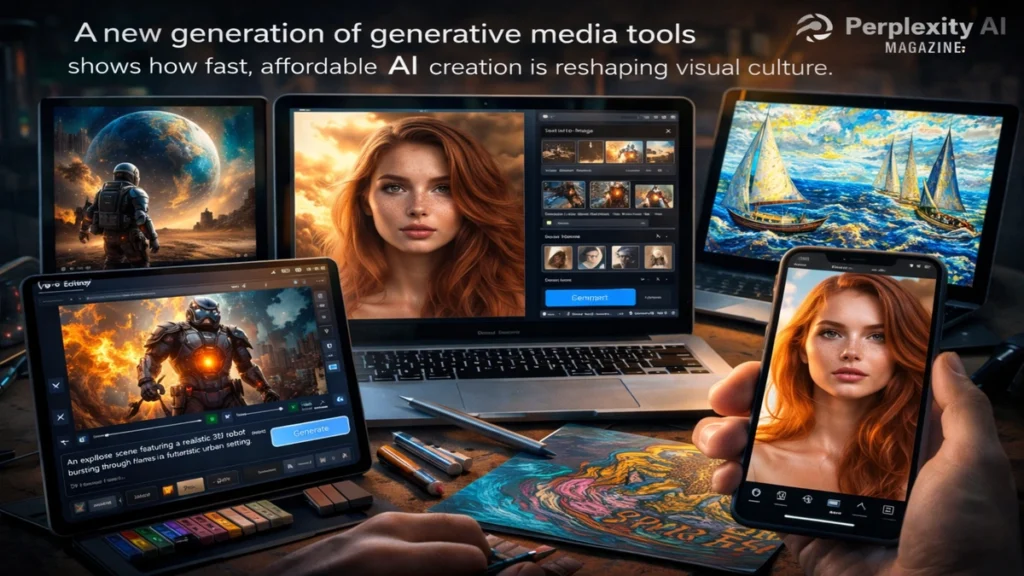
I approach geminigen.ai as part of a broader shift in how creative work is produced, distributed, and valued in the age of generative artificial intelligence. For readers searching this topic, the central question is straightforward within the first moments: what is GeminiGen.ai, how does it work, and why are creators paying attention to it now. The answer lies in its positioning as an accessible, multimodal AI platform focused on media generation rather than enterprise productivity or financial analytics.
GeminiGen.ai offers tools that convert text prompts into images, videos, and speech, emphasizing ease of use and cinematic control. Unlike many AI platforms that restrict advanced features behind expensive subscriptions or watermark outputs, GeminiGen.ai markets itself as open and creator-friendly. It allows users to experiment with high-resolution visuals, animated clips, and voice synthesis without logos or intrusive branding. That choice alone places it in contrast with more established platforms that monetize scarcity and professional exclusivity.
From my point of view, geminigen.ai is not attempting to replace professional film studios or visual effects houses. Instead, it targets a growing class of creators who need fast iteration, social media-ready formats, and creative freedom without production overhead. This article examines how GeminiGen.ai works, where it fits in the crowded AI media landscape, how it compares with competitors like Runway ML and Google Gemini, and why its pricing and design philosophy matter in a rapidly consolidating market.
The Emergence of Multimodal Generative Platforms
Generative AI did not begin with video. Text models and image generators laid the groundwork, proving that neural networks could translate language into visual form. Over time, multimodal systems emerged, combining text, images, audio, and motion into unified creative pipelines. I see geminigen.ai as a product of this evolution rather than a radical departure.
What distinguishes modern multimodal platforms is not only output quality, but integration. Users no longer want separate tools for image generation, animation, and voice. They want a single interface that allows ideas to move fluidly from concept to clip. GeminiGen.ai aligns with this expectation by supporting text-to-image, image-to-video animation, and speech synthesis within one environment.
This shift reflects a broader trend in creative industries. Marketing teams, designers, and independent creators increasingly work under tight timelines and platform-specific constraints. Vertical video, cinematic aspect ratios, and rapid A/B testing demand tools that can adapt quickly. geminigen.ai positions itself as a response to these pressures, offering flexibility without requiring technical expertise or large budgets.
Read: GME AI Explained: Stock Analysis, Hype, and Limits
Core Features and Creative Controls
At the heart of GeminiGen.ai is its emphasis on creative control layered on top of simplicity. I find that its Pro Studio mode illustrates this balance clearly. Users can specify subjects and actions, adjust lighting conditions, define camera angles, and choose aspect ratios optimized for platforms such as YouTube or TikTok. These controls borrow language from traditional cinematography while remaining accessible to non-professionals.
The platform supports multimodal prompts, meaning users can combine text descriptions with reference images to guide outputs. This approach reduces randomness and improves consistency, especially for branded content or character-driven visuals. Image-to-video animation allows still images to gain motion, turning static concepts into short clips suitable for social feeds or presentations.
Speech synthesis expands GeminiGen.ai beyond visuals. By integrating voice generation, the platform enables complete media packages without external editing software. This convergence of tools reflects an understanding that modern content creation is holistic rather than fragmented.
Accessibility and the Economics of Creation
One of the most notable aspects of GeminiGen.ai is its pricing strategy. I view its free tier, which provides access to advanced video models without watermarks, as a deliberate challenge to industry norms. Many competing platforms restrict high-quality outputs or impose visible branding unless users subscribe at higher price points.
GeminiGen.ai’s paid tier, priced around ten dollars per month, unlocks unlimited high-resolution outputs and priority features. This pricing undercuts many professional AI media platforms while avoiding token-based billing systems that can confuse or frustrate users. The result is a predictable cost structure aligned with creative experimentation.
This model reflects a broader democratization of production tools. Historically, cinematic visuals required expensive software and specialized skills. By lowering both financial and technical barriers, GeminiGen.ai contributes to a shift in who gets to create polished media and how often.
Use Cases Across Creative Industries
I see GeminiGen.ai’s strongest appeal among content creators, marketers, and designers who need speed and adaptability. Social media managers can generate platform-specific visuals in minutes. Designers can prototype concepts without commissioning full illustrations or animations. Independent creators can test narrative ideas visually before committing resources.
Examples often cited include animating stylized characters, visualizing science fiction environments, or producing short promotional clips. These use cases highlight time savings as much as cost reductions. Traditional workflows involving illustration, animation, and editing can take days or weeks. AI-assisted generation compresses that timeline dramatically.
This efficiency does not eliminate creative judgment. Instead, it shifts effort toward ideation and refinement. GeminiGen.ai’s iterative prompting supports this process, allowing creators to adjust outputs incrementally rather than starting from scratch.
Expert Perspectives on Generative Media Tools
“Multimodal AI platforms are redefining creative iteration,” said Dr. Elena Morales, a researcher in computational media. “The value is not just in generating content, but in how quickly creators can explore variations.”
Jason Liu, a digital marketing strategist, noted that watermark-free outputs are a significant differentiator. “For small teams, removing branding barriers changes how confidently they can deploy AI-generated visuals in campaigns.”
According to media technologist Aaron Feldman, pricing transparency matters as much as performance. “Creators want to know what they’re paying for. Flat subscriptions reduce friction and encourage experimentation.”
These perspectives reinforce the idea that GeminiGen.ai’s appeal lies as much in its design philosophy as in its technical capabilities.
Comparison With Runway ML
Runway ML represents a more established player in AI video generation, known for advanced editing tools and professional workflows. I find that comparing the two platforms highlights divergent priorities rather than simple superiority.
| Aspect | GeminiGen.ai | Runway ML |
|---|---|---|
| Core Strength | Fast multimodal generation | Advanced video editing |
| Free Tier | No watermarks | Watermarked outputs |
| Paid Entry | Around $10 per month | Higher entry costs |
| Target Users | Creators, marketers | Film and production teams |
Runway’s strengths lie in detailed control, including motion brushes and inpainting. GeminiGen.ai prioritizes accessibility and speed. The choice between them depends on whether a user values professional-grade editing or rapid content creation.
Positioning Relative to Google Gemini
Despite the name similarity, geminigen.ai is distinct from Google’s Gemini ecosystem. Google Gemini focuses on general-purpose AI across text, code, and enterprise productivity. Its higher-tier plans target advanced reasoning and large-scale integration rather than creative media alone.
GeminiGen.ai narrows its scope deliberately. By focusing on generative media, it avoids competing directly with enterprise AI offerings. This specialization allows it to optimize for creators rather than corporations, a strategic choice in a crowded market.
Timeline of Generative Media Evolution
| Period | Development |
|---|---|
| 2022 | Text-to-image tools gain mainstream adoption |
| 2023 | Early text-to-video models emerge |
| 2024 | Multimodal platforms integrate image, video, and audio |
| 2025 | Affordable, watermark-free tools expand creator access |
The Absence of Financial or Trading Context
It is important to note what geminigen.ai is not. I find no evidence linking it to stock trading, meme coins, or financial analytics. Unlike platforms associated with market prediction or crypto tracking, geminigen.ai remains focused on creative media generation.
This distinction matters because acronym overlap can mislead users. Understanding the platform’s true purpose helps set realistic expectations and prevents misapplication.
Takeaways
- GeminiGen.ai focuses on multimodal media generation.
- Watermark-free access lowers barriers for creators.
- Pricing emphasizes predictability over tokens.
- Pro Studio mode introduces cinematic controls.
- The platform targets speed and iteration.
- It is unrelated to trading or financial tools.
Conclusion
I see GeminiGen.ai as part of a broader movement toward accessible creativity powered by artificial intelligence. Its significance lies not in technical novelty alone, but in how it packages advanced capabilities for everyday creators. By offering multimodal generation without watermarks and at a low cost, it challenges assumptions about who can produce polished media.
As generative tools continue to evolve, platforms like geminigen.ai highlight a shift away from exclusivity toward participation. This does not eliminate the need for professional expertise, but it changes how ideas move from imagination to expression. In that sense, GeminiGen.ai is less about replacing creative labor and more about expanding who gets to take part in visual storytelling.
FAQs
What is GeminiGen.ai used for?
It is used to generate images, videos, and speech from text prompts for creative and marketing purposes.
Does GeminiGen.ai add watermarks?
No, outputs are watermark-free, even on the free tier.
Is GeminiGen.ai related to Google Gemini?
No, it is an independent platform focused on media generation.
Who benefits most from GeminiGen.ai?
Content creators, marketers, and designers who need fast visual prototypes.
Does GeminiGen.ai support video formats for social media?
Yes, it supports multiple aspect ratios optimized for major platforms.
