
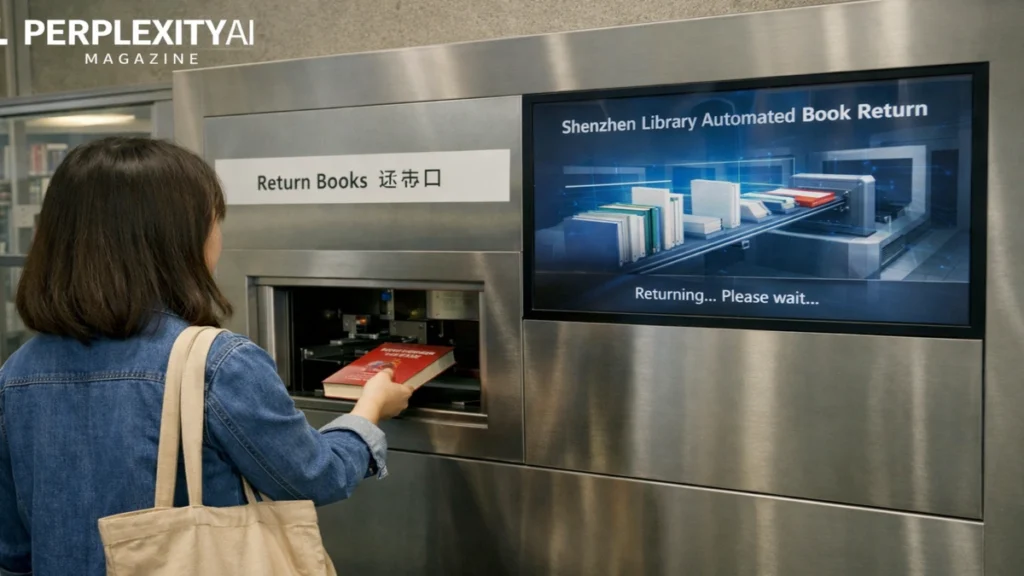
I first came across Bao’an Library while reading about how public services in China increasingly resemble high efficiency logistics hubs rather than traditional civic spaces. What stood out was not flashy humanoid robots or novelty demonstrations, but something far more mundane and telling: returned library books no longer pass through human hands at all. Readers drop them off, and machines take over everything that follows. – Robotic Libraries.
For many libraries worldwide, book returns remain one of the most labor intensive and error prone tasks. It is repetitive, physically demanding, and often invisible to patrons. Bao’an Library, located in Shenzhen’s rapidly expanding Bao’an District, has eliminated nearly all of that work through a fully robotic return and sorting system that runs end to end without human intervention.
In practical terms, the system handles up to 2,000 books per hour, sorting them into precise destinations using RFID tags and coordinated fleets of autonomous robots. Tasks that once took staff two full days during peak return periods now finish in a single morning. Librarians remain present, but their roles have shifted decisively toward reader services, programming, and curation.
This article examines how Bao’an Library’s system works, why it matters beyond efficiency gains, and what it reveals about the future of public institutions in China and elsewhere. The story is not about replacing people with machines. It is about how infrastructure quietly changes expectations of speed, labor, and human attention in everyday civic life.
A Library That Runs Like a Warehouse
Bao’an Library does not look like an industrial facility. From the outside, it resembles a contemporary cultural center with glass facades and wide reading halls. Behind the scenes, however, its return system operates more like an automated distribution warehouse than a traditional library back room.
Patrons return books at four self service windows, two indoors and two outdoors. Once deposited, books enter a conveyor network that transports them to a sorting area. There, RFID readers embedded in static workbenches scan each book’s tag, identifying title, category, and assigned shelving location. No barcode alignment or manual scanning is required. – Robotic Libraries.
The system then dispatches a fleet of 28 “Xiaozhi” sorting robots on the upper floor. These robots receive real time instructions, calculate optimal paths, avoid obstacles, and deliver books into one of 30 designated sorting slots. On the lower floor, four larger “Ruoyu” handling robots complete the process by transporting sorted books toward shelving zones for final placement.
According to library engineers, the system’s near zero error rate comes from its static unloading design. Each robot operates independently, reducing cascading failures and simplifying fault isolation. “It is less like a robot show and more like quiet infrastructure,” one Shenzhen based automation consultant noted in local media coverage.
Read: Dopple AI Explained: Inside the AI Character Chat Platform
How RFID Makes Full Automation Possible
At the heart of Bao’an Library’s system is radio frequency identification technology. Each book contains a passive RFID tag that stores unique identification data. Unlike barcodes, RFID does not require line of sight scanning, which allows books to be processed in bulk without precise alignment.
When books arrive at the sorting bench, RFID antennas emit radio waves that activate the tags. The background management system instantly retrieves book metadata and assigns a destination. This process occurs in milliseconds, enabling continuous flow rather than stop and scan handling.
RFID has been used in libraries for years, but Bao’an’s implementation removes humans entirely from the loop. The system does not merely assist staff. It replaces the sorting workflow altogether. That distinction matters because it shifts how libraries allocate labor and space.
A logistics researcher at Tsinghua University observed in a 2024 journal article that “RFID enabled autonomy transforms libraries from information storage sites into real time inventory systems.” In Bao’an, every returned book becomes a tracked object moving through a synchronized network of machines, closer to parcel sorting than archival handling. – Robotic Libraries.
The result is speed, consistency, and predictability, qualities increasingly expected in public services shaped by digital platforms.
Efficiency Gains That Changed Daily Operations
Before automation, Bao’an Library faced the same bottleneck as large urban libraries worldwide. During weekends and holidays, daily returns regularly exceeded 10,000 books. Sorting them manually required two full days of staff labor, creating backlogs and delaying circulation.
After deploying the robotic system between 2020 and 2022, that workload compressed dramatically. At 2,000 books per hour, even peak returns are cleared within hours. The library reports that staff once assigned to back room sorting now focus on programming, reader guidance, and collection development. – Robotic Libraries.
An internal operational comparison illustrates the change clearly.
| Metric | Manual Sorting | Robotic Sorting |
|---|---|---|
| Peak daily returns | 10,000 books | 10,000 books |
| Processing time | 48 hours | 5 to 6 hours |
| Error rate | Low but variable | Near zero |
| Staff required | 10 to 15 | 1 to 2 supervisors |
A senior librarian quoted by China Daily described the shift as cultural rather than technical. “Our work feels closer to public service now,” she said. “Less lifting, less repetition, more interaction.”
Robots That Coordinate Without Human Oversight
The most striking feature of Bao’an’s system is not individual robot capability, but coordination. The Xiaozhi robots operate as a fleet, receiving instructions from a centralized management system that continuously optimizes traffic flow. – Robotic Libraries.
Each robot plans its path dynamically, adjusting to obstacles or temporary congestion. If one robot pauses for charging, others reroute automatically. Charging stations are integrated into the workflow, allowing robots to dock autonomously during idle windows without disrupting throughput.
On the lower floor, Ruoyu robots handle heavier transport tasks. Their role is less about speed and more about stability, ensuring sorted batches reach shelving zones safely. The two robot types complement each other, resembling the layered automation seen in modern fulfillment centers.
An engineer involved in the deployment told Southern Weekly that independence was a deliberate design choice. “We avoided a single point of failure. If one robot stops, the system continues.”
This architecture reflects a broader trend in Chinese robotics toward robustness over spectacle.
From Bao’an to Shanghai and Beyond
Bao’an Library is often described as China’s first fully robotic sorting library, a claim that gained viral attention on Chinese social platforms in January 2026. While other libraries use RFID and partial automation, Bao’an remains distinctive for eliminating human sorting entirely.
Its influence is already visible. Shanghai Library East has deployed AI assisted book delivery robots and automated sorting lines inspired by Bao’an’s model. University libraries in Nanjing and Wuhan have adopted RFID inventory robots capable of scanning shelves five times faster than staff, achieving reported accuracy rates above 98 percent.
The progression can be summarized across institutions.
| Library | Technology Focus | Deployment Period |
|---|---|---|
| Bao’an Library, Shenzhen | Full robotic sorting and handling | 2020–2022 |
| Shanghai Library East | Automated sorting and delivery | 2022–2024 |
| Wuhan University Library | RFID inventory robots | 2019–2021 |
| Nanjing University Library | Shelf scanning automation | 2018–2020 |
A policy analyst at the Chinese Academy of Social Sciences described this as part of a broader public robotics strategy. “Libraries are ideal test beds,” he wrote in 2023. “High volume, low risk, clear metrics.”
What Happens to Librarians When Robots Take Over
Automation anxiety often centers on job loss. Bao’an Library offers a more nuanced outcome. Staff numbers have not collapsed. Instead, roles have shifted.
Sorting and physical handling positions have declined, but programming, outreach, and reader advisory roles have expanded. Librarians now spend more time guiding users through digital resources, hosting events, and supporting research.
A 2024 survey by the Shenzhen Municipal Bureau of Culture found that staff satisfaction increased after automation, largely due to reduced physical strain. “The robots took the hardest part of the job,” one respondent noted.
International experts see parallels elsewhere. A British library technologist writing in Information Today argued that “automation removes drudgery, not expertise, when implemented with clear institutional goals.”
Bao’an’s case supports that view. The robots did not replace librarians. They redefined what librarianship looks like in a high throughput urban environment. – Robotic Libraries.
Libraries as Civic Infrastructure, Not Nostalgia
The image of libraries as quiet, analog refuges persists in popular imagination. Bao’an challenges that idea directly. Its return system is loud, mechanical, and unapologetically industrial behind closed doors.
Yet the public experience remains calm. Readers encounter faster availability, fewer missing books, and more engaged staff. The machinery stays out of sight, reinforcing a separation between user experience and operational complexity.
Urban sociologists argue this reflects a broader Chinese approach to public technology. “Efficiency is treated as a form of care,” wrote sociologist Sun Peidong in a 2025 essay. The smoother the service, the less visible the labor behind it.
Bao’an Library embodies that philosophy. Its robots do not greet patrons or perform. They work continuously, invisibly, redefining what a public institution can be when logistics thinking replaces tradition.
Takeaways
- Bao’an Library operates one of the world’s first fully robotic book return systems.
- RFID technology enables bulk identification without human scanning.
- Robots process up to 2,000 books per hour with near zero errors.
- Automation reduced sorting time from days to hours.
- Librarian roles shifted toward patron services rather than manual labor.
- Similar systems are spreading across Chinese libraries.
- The model reflects China’s broader public robotics strategy.
Conclusion
I see Bao’an Library not as a futuristic curiosity, but as a quiet indicator of where public infrastructure is heading. The transformation did not arrive with spectacle or controversy. It arrived through conveyors, tags, and machines doing repetitive work better than humans ever could.
What makes the story compelling is its ordinariness. Returning a book is one of the simplest civic actions imaginable. When even that becomes fully automated, it forces a reconsideration of how societies value time, labor, and human presence. – Robotic Libraries.
Bao’an’s robots did not eliminate librarians. They removed friction. In doing so, they exposed a question libraries everywhere will eventually face: what work truly requires human judgment, and what work merely survives because tradition demands it?
As other cities watch Shenzhen’s experiment, the answer may shape not only libraries, but the future design of public services themselves.
FAQs
How do Bao’an Library’s robots identify books?
Each book contains a passive RFID tag that stores unique identification data readable via radio waves.
Can the system handle damaged or untagged books?
Damaged or untagged items are diverted for manual review, though these cases are rare.
When was the robotic system deployed?
The system was gradually deployed between 2020 and 2022.
Are similar systems used outside China?
Partial RFID automation exists globally, but full robotic sorting remains uncommon.
Did automation reduce library staff numbers?
No major layoffs were reported. Staff roles shifted toward patron focused services.
