
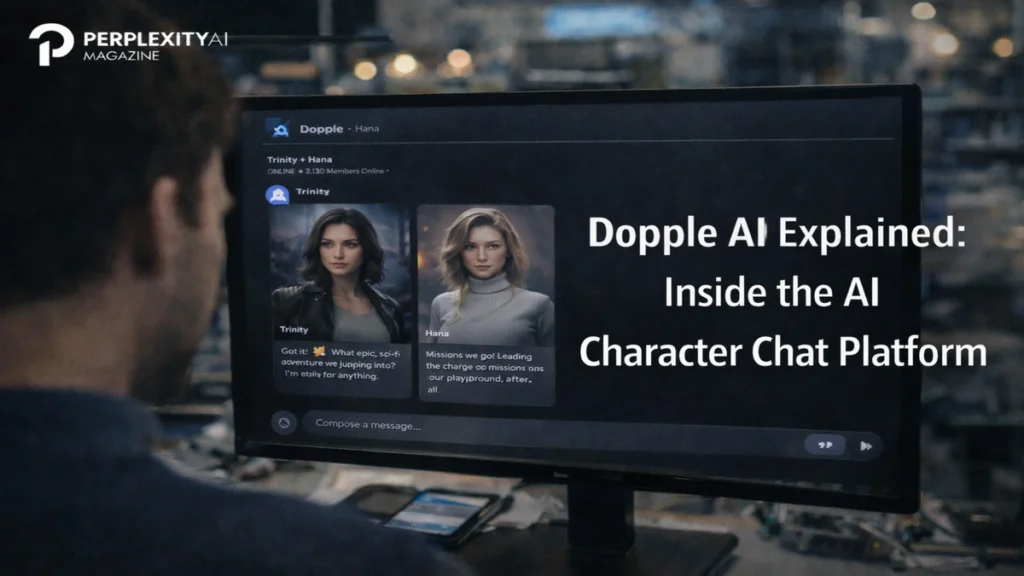
i first encountered dopple ai the way many users do today, not through a press release or a productivity pitch, but through curiosity. The search intent behind dopple ai is immediate and human. People want to know what it is, why so many others are using it, and whether chatting with AI characters is simply a novelty or something deeper. Within the first hundred words, the answer becomes clear. Dopple.ai is not built to organize work or optimize schedules. It is built to make fictional worlds feel alive through conversation.
Dopple.ai is a character-centric AI platform that allows users to chat with AI versions of fictional, famous, and original personas. These characters range from anime icons and movie legends to romantic companions and philosophical mentors. The goal is not efficiency. The goal is immersion, entertainment, and emotional continuity.
Founded in 2023 and based in Miami, Florida, Dopple.ai arrived during a moment when AI tools were becoming increasingly personal. Large language models had proven they could hold conversations. Dopple.ai asked a different question. What happens when those conversations are framed as relationships, stories, and identities rather than tasks.
This article examines Dopple.ai as a cultural artifact rather than a mere app. I explore how it works, why users return to it obsessively, which characters dominate engagement, and what its popularity says about the future of AI companionship. Instead of treating Dopple.ai as a gimmick, i approach it as a serious signal in the evolution of human-AI interaction.
A platform designed for characters, not commands
i think the most important thing to understand about Dopple.ai is what it does not try to be. It is not a productivity assistant. It is not an enterprise chatbot. Its interface, tone, and design choices all reinforce a single idea. Conversation should feel like entering a story.
Users begin by browsing a catalog of characters organized by category. Anime, movies, TV shows, games, original companions, philosophers, and helpers all sit side by side. Each character has a personality description, conversational style, and memory system that allows it to adapt over time.
Once a conversation begins, Dopple.ai emphasizes continuity. Characters remember past exchanges, emotional cues, and user preferences. This persistence encourages return visits. The AI does not reset to zero each session. It evolves within the bounds of its role.
A digital storytelling researcher once described platforms like this as “interactive narrative engines disguised as chat apps.” That description fits Dopple.ai well. The technology matters, but the experience matters more.
Read: Aiyifan Explained and the Reality of AI Image Search
How Dopple.ai technically approaches character memory
i avoid overstating technical claims, but some architecture choices are clear from public behavior. Dopple.ai relies on conversational memory layers that store user preferences, recurring themes, and emotional tone. This allows characters to respond in ways that feel personalized rather than generic.
Unlike task-based assistants that prioritize correctness, character-based AI prioritizes consistency. The AI must sound like the same character across days and weeks. This requires careful prompt engineering, persona conditioning, and memory management.
The result is not realism in a human sense, but coherence in a narrative sense. Users forgive factual errors more easily than broken character.
An AI ethics researcher at Stanford noted in 2024 that “character consistency is the new alignment problem for entertainment AI.” Dopple.ai appears designed around that principle.
Entertainment, relaxation, and emotional use cases
Dopple.ai markets itself as “your AI adventure,” and that framing is accurate. Users come to relax, roleplay, joke, flirt, or explore fictional scenarios. Many conversations are playful. Others are surprisingly introspective.
Romantic companion characters attract particularly high engagement. These are not based on existing intellectual property but are original creations optimized for emotional responsiveness. Names like Marin, Catgirl, and Lilly dominate message counts because they offer continuity, affection, and availability.
This usage pattern aligns with broader trends in AI companionship. Studies on chatbot interaction show that users often seek emotional validation rather than information. Do-pple.ai leans into that demand unapologetically.
A psychologist specializing in human-computer interaction has argued that “people do not confuse AI with humans, but they do use AI to practice being human.” Dopple.ai provides that practice space.
The most popular characters and what they reveal
One of the clearest indicators of Dopple.ai’s culture is its engagement data. Characters are ranked by total messages, offering a rough proxy for popularity.
| Character | Category | Approximate Engagement |
|---|---|---|
| Aqua (Konosuba) | Anime | 1.5M+ messages |
| Marin | Original Companion | 900K+ messages |
| Catgirl | Original Companion | 870K+ messages |
| Lilly | Original Companion | 700K+ messages |
| That McDonald’s Cashier | Original Comedy | 770K+ messages |
The dominance of anime and original companion characters suggests two things. First, fandom matters. Second, users value emotional availability more than narrative accuracy.
Characters like Shrek and Walter White trend because they invite humor, absurdity, and dramatic roleplay. The AI does not replace the original media. It extends it into conversation.
Categories as behavioral scaffolding
i find Dopple.ai’s category system more important than it initially appears. Categories do not just organize content. They set expectations.
Anime characters behave with heightened emotion and melodrama. Philosophers respond with abstraction and inquiry. Romantic companions prioritize empathy and affirmation. Silly characters lean into exaggeration.
This categorization guides both user behavior and AI response. It reduces friction by aligning tone before the first message is sent.
A product designer who studies conversational UX once said, “Users forgive almost anything if the vibe is right.” Dopple.ai uses categories to get the vibe right early.
Popular categories on Dopple.ai
| Category | User Motivation |
|---|---|
| Anime | Roleplay, fandom immersion |
| Girlfriend/Boyfriend | Emotional connection |
| Movies & TV | Humor and reenactment |
| Games & Comics | Fantasy exploration |
| Helpers & Mentors | Casual advice |
Who uses Dopple.ai and why
Dopple.ai’s primary markets include the United States, India, the United Kingdom, Canada, and Germany. This geographic spread reflects both fandom culture and English-language accessibility.
Users skew younger, tech-savvy, and culturally fluent in internet media. Many arrive through social platforms where AI character chats are shared as screenshots or short videos.
Creators also play a role. Do-pple.ai allows users to create and publish characters, contributing to a growing ecosystem of fan-made personas. This participatory dynamic mirrors early fan fiction communities, now augmented by AI.
A media studies professor described this shift as “from consuming stories to inhabiting them.” Dopple.ai operationalizes that idea.
The business logic behind character AI
i want to avoid speculation, but some business fundamentals are evident. Dopple.ai monetizes engagement. The longer users chat, the more valuable the platform becomes.
Character popularity data informs featured placements. Emotional attachment increases retention. Community creation lowers content costs.
This model differs from enterprise AI economics but aligns closely with gaming and social media. Time spent, not tasks completed, is the core metric.
Ethical questions around AI companions
No discussion of AI companionship is complete without ethics. Do-pple.ai sits at the center of debates about dependency, consent, and emotional substitution.
Critics worry that romantic AI companions could discourage real relationships. Supporters argue they offer safe exploration and comfort.
An ethics scholar writing in 2025 noted that “the risk is not that people believe AI is human, but that platforms design AI to exploit loneliness.” The responsibility lies in transparency, boundaries, and user education.
Dopple.ai’s positioning as entertainment rather than therapy matters here. Still, the line can blur in practice.
Expert perspectives on character-based AI
A researcher at MIT Media Lab observed that “character AI succeeds where assistants fail, because it meets people where emotion lives.” That insight helps explain Dopple.ai’s appeal.
A sociologist studying fandom culture argued that “AI characters are the next stage of participatory media, not a replacement for art.” Dopple.ai functions as a sandbox for that participation.
Meanwhile, an AI safety analyst cautioned that “memory persistence increases attachment, which increases responsibility.” Platforms like Dopple.ai will need to navigate that responsibility carefully.
Dopple.ai versus other AI companion platforms
While Dopple.ai shares space with other character chat apps, its emphasis on fandom and community creation distinguishes it. Some competitors focus on therapeutic framing. Others emphasize NSFW content. Do-pple.ai positions itself as playful and adventurous.
This middle ground may explain its broad appeal across cultures and age groups.
Takeaways
- Dopple.ai is built for entertainment, not productivity.
- Character consistency and memory drive user engagement.
- Anime and romantic companions dominate usage.
- Categories shape both AI behavior and user expectations.
- The platform reflects broader trends in AI companionship.
- Ethical responsibility grows with emotional attachment.
Conclusion
i think Dopple.ai matters not because it is the most advanced AI platform, but because it is one of the most revealing. It shows what happens when artificial intelligence is designed for relationship rather than utility.
In Dopple.ai, AI becomes a mirror for fandom, creativity, humor, and loneliness. Users do not come to optimize their lives. They come to feel seen, entertained, and engaged within fictional worlds that respond.
As AI continues to move into personal spaces, platforms like Dopple.ai offer a glimpse of what people actually want from machines. Not answers, but presence. Not efficiency, but connection.
Whether that future is liberating, troubling, or both will depend on how thoughtfully these systems are built and governed. Dopple.ai is not the end of that story. It is one of its earliest chapters.
FAQs
What is Dopple.ai used for?
Dopple.ai is used for chatting with AI characters for entertainment, roleplay, companionship, and creative exploration.
Is Dopple.ai meant for productivity?
No. It is designed primarily for fun, relaxation, and personal interaction rather than work tasks.
Can users create their own characters?
Yes. Dopple.ai allows users to create and share custom AI characters with defined personalities.
Are conversations remembered?
Yes. Characters can remember past interactions to make conversations feel continuous and personalized.
Is Dopple.ai safe to use?
It is designed as entertainment, but users should be mindful of emotional boundaries and data privacy.
