
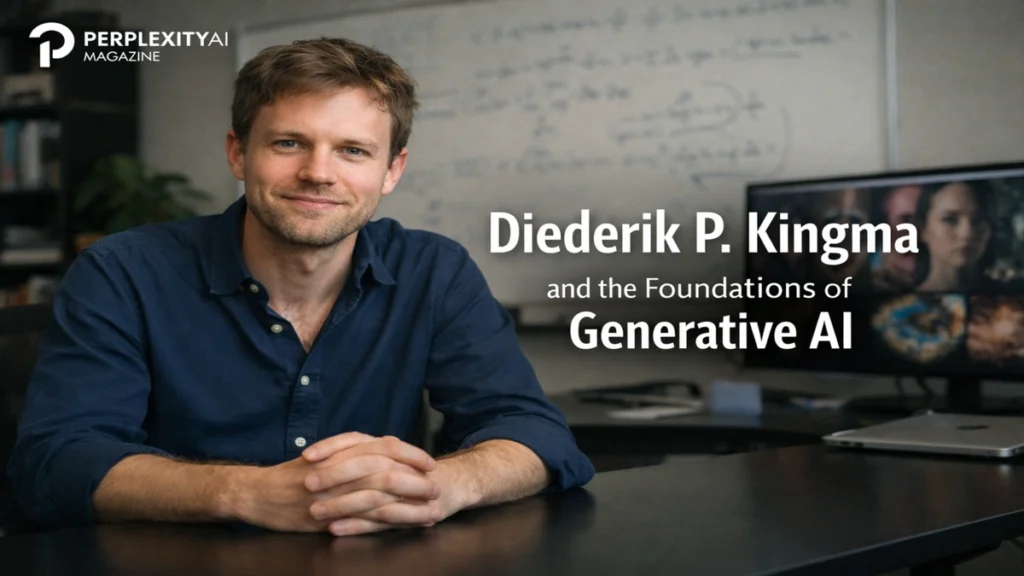
i want to begin with a simple observation that often gets lost in discussions about artificial intelligence. Most of the systems shaping the world today were not born from flashy demos or viral announcements. They emerged from careful mathematical work carried out years earlier by researchers whose names rarely trend on social media. diederik p. kingma belongs squarely in that category.
Within the first hundred words, the search intent becomes clear. Readers looking up diederik p. kingma want to know who he is, what he actually invented, and why his name keeps appearing in research papers, AI tools, and academic citations. The short answer is that much of modern generative AI would look very different without his contributions. The longer answer requires context, history, and patience.
Kingma is a Dutch machine learning researcher whose work helped bridge probabilistic modeling and deep neural networks. His research sits beneath techniques that power image generation, language models, diffusion systems, and large scale optimization. Two of his ideas stand out immediately. One is the Variational Autoencoder, a framework that made latent variable generative models scalable. The other is Adam, an optimization algorithm now used almost everywhere deep learning is practiced.
This article takes a long view of Kingma’s career and influence. I trace his academic roots, explain his most important papers in human language, and examine why his work continues to matter in 2026. Rather than treating him as a celebrity scientist, I approach him as what he actually is: a foundational thinker whose ideas quietly became infrastructure.
Early academic roots and intellectual lineage
i often find that the most revealing way to understand a researcher is to look at their academic lineage. Kingma earned his doctorate at the University of Amsterdam under Max Welling, a leading figure in probabilistic machine learning. His dissertation, “Variational Inference and Deep Learning: A New Synthesis,” signaled the direction his work would take. – diederik p. kingma.
At the time, deep learning was surging, but probabilistic modeling struggled to scale. Variational inference offered elegant theory but practical limits. Neural networks offered flexibility but often lacked principled uncertainty modeling. Kingma focused on unifying these worlds.
This intellectual synthesis mattered because it solved a practical problem. How do you train generative models that can learn complex data distributions without collapsing under computational cost. His work answered that question with mathematical clarity and algorithmic efficiency.
Colleagues from that period describe Kingma as methodical rather than performative. He was not chasing benchmarks for attention. He was trying to make ideas work reliably. That orientation would later define the unusually durable impact of his research.
The Variational Autoencoder and why it mattered
i still remember when Variational Autoencoders began circulating as preprints in 2013. At first glance, the idea seemed technical and abstract. In practice, it changed how researchers thought about generative modeling.
The VAE introduced a way to learn latent representations using neural networks while preserving a probabilistic foundation. Instead of directly generating data, the model learned a structured latent space from which data could be sampled. This allowed for interpolation, uncertainty estimation, and meaningful representation learning.
The importance of VAEs goes beyond images. They influenced natural language processing, anomaly detection, recommendation systems, and later diffusion models. Even when newer techniques surpassed VAEs in visual fidelity, the conceptual framework remained influential.
An expert in probabilistic modeling once summarized it succinctly. “The VAE made probabilistic generative models usable by engineers, not just theorists.” That usability is why Kingma’s name remains embedded in modern AI curricula.
Read: Copyright AI News: Lawsuits, Policy, and Strategy in 2026
Adam and the invisible engine of deep learning
If the VAE shaped how models think, Adam shaped how they learn. Published in 2014 with Jimmy Ba, Adam introduced an adaptive learning rate method that combined ideas from momentum and RMSProp.
The brilliance of Adam lies in its practicality. It works well out of the box. It handles noisy gradients. It scales to large models. These properties made it the default optimizer in countless frameworks.
Today, most practitioners use Adam without thinking about it. That invisibility is a mark of success. When infrastructure disappears from attention, it usually means it works.
A senior engineer at a major AI lab once noted that “changing Adam would break half the training pipelines in production.” That dependence underscores how deeply Kingma’s work has been absorbed into the field.
Timeline of key contributions
| Year | Contribution | Significance |
|---|---|---|
| 2013 | Auto-Encoding Variational Bayes | Introduced the VAE framework |
| 2014 | Adam optimizer | Standardized adaptive optimization |
| 2016 | Inverse Autoregressive Flow | Improved variational inference |
| 2018 | Glow | Advanced flow-based generative models |
| 2021 | Variational Diffusion Models | Linked diffusion and variational methods |
From academia to industry research labs
i am cautious about overstating the importance of institutional affiliations, but in Kingma’s case they matter. He was part of the founding research team at OpenAI during its early, exploratory phase. There, he helped shape research priorities around generative modeling and scalable learning.
After OpenAI, he joined Google Brain and later DeepMind. These environments provided access to compute and datasets necessary to test theoretical ideas at scale. His later work on diffusion and flow models reflects that shift.
What is notable is continuity. Kingma did not abandon his probabilistic roots. Instead, he extended them into larger systems. His research maintained a throughline from early theory to modern foundation models.
Expert perspectives on his influence
A professor of machine learning at Stanford described Kingma as “a researcher whose ideas age well.” According to her, many papers look impressive at publication but fade. His continue to gain citations years later.
Another expert from DeepMind noted that “Kingma’s work is rarely about winning a benchmark. It is about making entire classes of models viable.” That distinction explains his enduring relevance.
A third voice, a senior researcher in generative modeling, put it bluntly. “If you remove Adam and VAEs from the literature, the field loses a decade.” While hypothetical, the statement captures how foundational these contributions are.
Glow and the flow-based renaissance
Glow, introduced in 2018, revived interest in flow-based generative models. Unlike VAEs, flows offer exact likelihoods and invertible transformations. Glow’s innovation was architectural simplicity combined with expressive power.
Although diffusion models later captured more attention, Glow influenced thinking about invertibility and latent structure. Many modern architectures borrow ideas first clarified in flow-based research.
This pattern repeats across Kingma’s career. He often opens doors that others later walk through with different tools.
Connecting variational inference to diffusion
i find Kingma’s work on variational diffusion models particularly revealing. Rather than treating diffusion as a separate paradigm, he framed it within variational inference. This reframing helped unify generative modeling under a common mathematical language.
The impact of this unification is subtle but important. It allows researchers to compare methods, reason about tradeoffs, and design hybrids. In a field prone to fragmentation, that coherence matters.
Why his name trends in keyword tools
From an SEO perspective, diederik p. kingma functions as a signal term. His name correlates with foundational AI concepts, high citation counts, and educational material. Searches for his name often reflect learning intent rather than celebrity curiosity.
This explains why analytics dashboards surface his name. He represents credibility, depth, and long-term value rather than hype.
Table of major papers and themes
| Paper | Theme | Lasting Impact |
|---|---|---|
| Adam | Optimization | Default training method |
| VAE | Generative modeling | Latent representation learning |
| Glow | Flow models | Invertible architectures |
| Diffusion models | Probabilistic synthesis | Unified theory |
Takeaways
- Kingma’s work forms infrastructure rather than surface features.
- Variational Autoencoders reshaped generative modeling.
- Adam became the default optimizer across deep learning.
- His research bridges theory and scalable practice.
- Influence persists even when newer models dominate headlines.
Conclusion
i think the most honest way to understand diederik p. kingma is to see him not as a singular genius moment, but as a steady force. His ideas did not explode overnight. They accumulated, integrated, and normalized.
In an era obsessed with rapid breakthroughs, his career reminds us that progress often comes from making ideas usable. By turning theory into tools, he enabled thousands of others to build, experiment, and extend.
As generative AI continues to evolve, his contributions remain embedded in its foundations. That is a rare achievement. Not because it dazzles, but because it endures.
FAQs
Who is diederik p. kingma?
He is a Dutch machine learning researcher known for foundational work in generative models and optimization.
Why is the Adam optimizer important?
Adam simplifies and stabilizes neural network training and is widely used across deep learning applications.
What is a Variational Autoencoder?
A probabilistic generative model that learns structured latent representations using neural networks.
Did Kingma work at OpenAI?
Yes, he was part of OpenAI’s early research team before joining Google Brain and DeepMind.
Why does his work still matter today?
His ideas underpin modern generative and optimization techniques used in current AI systems.
