
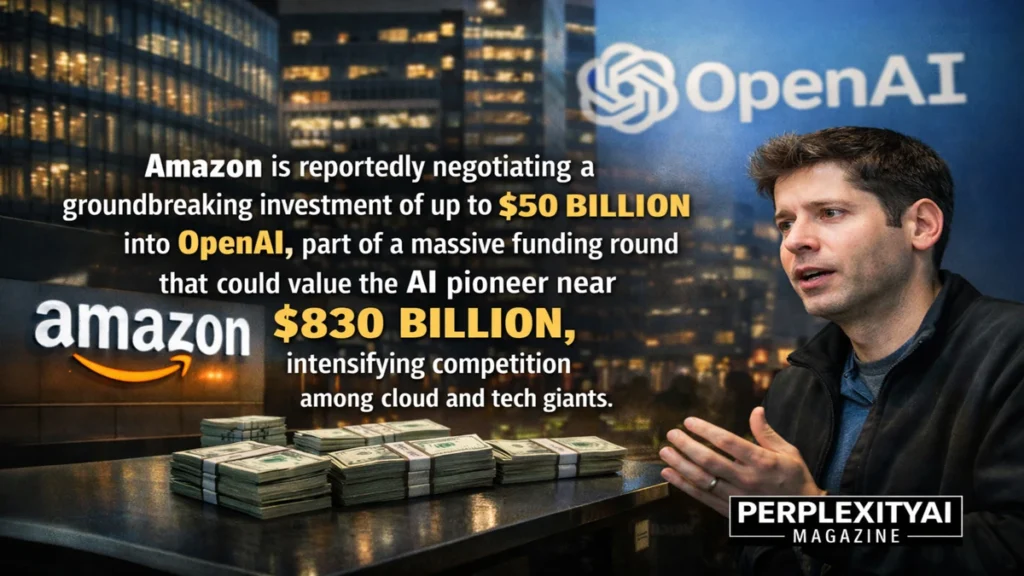
I begin this story from a place of scale rather than spectacle, because the reported talks between Amazon and OpenAI are less about drama than about gravity. Amazon is in discussions to invest up to $50 billion in OpenAI as part of a massive new funding round that could total around $100 billion and value the AI company near $830 billion. The deal is not finalized, the amount could change, and the structure remains fluid. Still, even in unfinished form, the talks offer a clear signal about where power is consolidating in the technology industry. – amazon openai investment.
In the first moments of this news, what matters most is not the number itself, staggering as it is, but what that number represents. Artificial intelligence at the frontier now demands capital on a scale once reserved for nation states, energy grids, or global transportation systems. Training and running large language models requires enormous computing resources, custom chips, data centers, and long-term commitments to electricity, cooling, and land. OpenAI’s negotiations with Amazon reflect that reality.
From Amazon’s perspective, the potential investment is not about choosing a single AI champion. It is about ensuring that Amazon Web Services remains indispensable to whoever defines the next era of artificial intelligence. From OpenAI’s side, the talks reflect a need to secure both capital and compute at a level that supports its ambitions. This is a story about infrastructure, leverage, and the economics of intelligence at scale.
The Shape of the Deal Under Discussion
I approach the structure of the proposed investment with caution, because much of it remains under negotiation. What is known is that Amazon is discussing an investment of up to $50 billion in OpenAI as part of a broader fundraising effort that could reach approximately $100 billion. This would place OpenAI’s valuation at roughly $830 billion, a sharp increase from its previous valuation near $500 billion. – amazon openai investment.
The investment is expected to be a minority stake, though the precise percentage has not been disclosed. Industry observers believe the round could be structured in multiple tranches, beginning with strategic technology partners such as Amazon, followed by additional participation from other corporations, sovereign wealth funds, and large institutional investors. This staged approach allows OpenAI to balance strategic alignment with financial diversification.
Unlike traditional venture capital rounds, this funding discussion is inseparable from infrastructure commitments. Amazon’s capital would likely be tied to expanded agreements for OpenAI to purchase cloud computing capacity from Amazon Web Services. In effect, Amazon would be investing in OpenAI while OpenAI commits to spending a significant portion of that investment on Amazon’s own infrastructure over many years.
This circular structure is increasingly common in frontier AI financing. Capital flows in, but much of it flows back out in the form of long-term cloud contracts, chip purchases, and data center usage. The result is a deal that functions as both an equity investment and a revenue guarantee. – amazon openai investment.
Read: Meet Clawdbot: The Local AI Agent Redefining What Assistants Do
Why Amazon Is at the Table
I view Amazon’s interest in OpenAI less as a bet on one company’s success and more as a calculated move to protect and expand its cloud dominance. Amazon Web Services already generates tens of billions of dollars in annual revenue and underpins much of the modern internet. Artificial intelligence represents its next great demand engine.
Training large AI models requires massive clusters of GPUs or custom accelerators operating for months at a time. Inference, the process of running models in real-world applications, requires continuous compute at global scale. These workloads are ideally suited to hyperscale cloud providers, and AWS wants to ensure it hosts as many of them as possible.
By investing in OpenAI, Amazon gains leverage to negotiate long-term infrastructure commitments that lock OpenAI into AWS. At the same time, Amazon reduces the risk that a rival cloud provider secures exclusive control over OpenAI’s future compute needs. The investment is therefore defensive as much as it is offensive.
This strategy also aligns with Amazon’s broader philosophy. Historically, Amazon has prioritized long-term cash flow, infrastructure utilization, and ecosystem control over short-term profits. A $50 billion investment that drives decades of cloud revenue fits squarely within that worldview.
The Anthropic Parallel
I cannot discuss Amazon’s OpenAI talks without addressing Anthropic, another leading AI company that Amazon already backs heavily. Amazon has invested billions in Anthropic and committed to building large data center capacity dedicated to running Anthropic’s models. AWS is Anthropic’s primary cloud and training partner.
At first glance, supporting two competing AI labs might seem contradictory. In practice, it reveals Amazon’s core objective. Amazon is not trying to pick a single AI winner. It is trying to ensure that whichever company succeeds, AWS is deeply embedded in its operations. – amazon openai investment.
This dual-track strategy hedges against uncertainty in a field where technical breakthroughs, regulatory changes, or market shifts can quickly alter the balance of power. OpenAI may remain the most visible consumer brand in AI, while Anthropic may gain ground in enterprise and safety-focused deployments. Amazon benefits either way if both rely on AWS.
The approach mirrors earlier strategies in other industries, where infrastructure providers profit by supporting multiple competitors rather than betting exclusively on one.
OpenAI’s Expanding Appetite for Capital
From OpenAI’s perspective, the talks with Amazon highlight the immense financial demands of frontier AI development. Training next-generation models requires not only advanced chips but also the energy, networking, and operational capacity to deploy them at global scale.
OpenAI’s strategy has increasingly focused on securing long-term compute commitments alongside capital. Rather than raising smaller rounds every year, the company is now seeking funding on a scale that supports multi-year planning for data centers, hardware procurement, and model development.
A $100 billion funding round would give OpenAI the ability to negotiate from a position of strength with cloud providers and chip manufacturers. It would also provide a buffer against volatility in capital markets and regulatory uncertainty. – amazon openai investment.
At the same time, such scale raises questions about governance, influence, and independence. Large investors often seek board seats or observer rights, and infrastructure partners may push for technical decisions that align with their platforms. Balancing these pressures will be one of OpenAI’s central challenges if the round closes.
Microsoft’s Enduring Role
I cannot ignore Microsoft’s presence in this ecosystem. Microsoft remains OpenAI’s most important commercial partner, with long-standing agreements that give Azure exclusive rights to market OpenAI’s models to enterprise customers. That relationship is not expected to change as a result of Amazon’s talks.
Any Amazon investment would likely be structured to avoid conflicting with Microsoft’s existing arrangements. Amazon’s stake would be primarily financial and infrastructural rather than commercial. This distinction allows OpenAI to diversify its infrastructure risk without undermining its core go-to-market strategy.
The situation underscores how modern AI companies operate within webs of overlapping alliances rather than simple, exclusive partnerships. OpenAI can rely on Microsoft for commercialization while leveraging Amazon for additional compute and capital.
Nvidia and the Hardware Layer
Another dimension of this story sits beneath the cloud, at the level of chips. Nvidia’s processors remain central to training and running large AI models, and Nvidia is also reported to be in discussions about participating in OpenAI’s broader funding round.
This creates a layered ecosystem in which capital, cloud services, and hardware are tightly intertwined. Amazon invests capital and provides cloud infrastructure. Nvidia supplies the chips. OpenAI orchestrates the models. Each party benefits from the others’ growth, even as they negotiate fiercely over pricing and access.
For Amazon, supporting OpenAI also creates an opportunity to promote its own custom AI chips over time. If OpenAI adopts Amazon-designed accelerators for certain workloads, the strategic value of the investment increases beyond pure cloud revenue.
A Circular Model of AI Finance
I find the most revealing aspect of these talks to be the circularity of modern AI financing. Amazon invests billions in OpenAI. OpenAI uses that capital to buy cloud services from Amazon. Amazon reports higher AWS revenue, which supports further investment in infrastructure and chips.
This loop blurs the line between investor and customer. It also complicates traditional valuation metrics, because part of the return on investment comes not from equity appreciation but from predictable, long-term operating revenue.
In this model, the success of the investment depends less on an eventual exit and more on sustained usage. As long as OpenAI continues to train larger models and deploy them at scale, Amazon benefits regardless of whether OpenAI goes public, remains private, or restructures.
Timeline of Key Developments
| Period | Development |
|---|---|
| Early 2025 | OpenAI begins exploring ultra-large funding rounds to support next-generation models |
| Late 2025 | Amazon deepens investment and infrastructure commitments to Anthropic |
| January 2026 | Reports emerge of Amazon talks to invest up to $50 billion in OpenAI |
| Early 2026 | OpenAI negotiates with multiple strategic partners for a $100 billion round |
Expert Perspectives on the Stakes
Several industry analysts view these talks as a natural evolution rather than an anomaly. One cloud economist describes the move as “the logical endpoint of AI’s infrastructure needs meeting hyperscale capital.” Another technology strategist notes that such deals effectively turn cloud providers into long-term stakeholders in AI research agendas.
An academic expert in technology governance warns that concentration of compute and capital could raise policy concerns, particularly around competition and access. At the same time, she acknowledges that no smaller entities can realistically support AI development at this scale.
Implications for the AI Race
I see these negotiations as a marker of a new phase in the AI race. The question is no longer which startup has the best model today, but which organizations can sustain the infrastructure required to improve those models year after year.
Amazon’s approach suggests that the real battleground lies beneath the applications layer, in data centers, power contracts, and chip supply chains. OpenAI’s willingness to engage with multiple infrastructure partners reflects a desire to avoid dependency on any single provider, even as it relies on all of them.
If the deal proceeds, it will likely accelerate consolidation at the top of the AI ecosystem while widening the gap between frontier labs and smaller competitors.
Takeaways
• Amazon is in talks to invest up to $50 billion in OpenAI, though no agreement is final.
• The potential round could value OpenAI at roughly $830 billion.
• The investment is closely tied to long-term AWS infrastructure commitments.
• Amazon’s strategy focuses on cloud dominance rather than picking one AI winner.
• OpenAI is seeking capital at unprecedented scale to support rising compute demands.
• The deal reflects a broader shift toward circular financing in AI.
Conclusion
I end this analysis with a sense that these talks are less about one transaction than about a structural shift. Amazon and OpenAI are negotiating within a world where intelligence has become an industrial product, dependent on capital and infrastructure measured in tens of billions of dollars. Whether the deal closes at $50 billion or a smaller figure, its significance lies in what it reveals about power in the AI era.
Cloud providers are no longer neutral platforms. They are financiers, partners, and gatekeepers. AI labs are no longer lean research organizations. They are infrastructure-hungry enterprises shaping global demand for compute and energy. The outcome of these talks will ripple far beyond the balance sheets of the companies involved, influencing how artificial intelligence is built, funded, and controlled in the years ahead.
FAQs
Is the Amazon investment in OpenAI finalized?
No. The discussions are ongoing, and the terms, structure, and final amount have not been finalized.
Why would Amazon invest while backing Anthropic?
Amazon’s strategy is to secure cloud workloads regardless of which AI lab ultimately leads the market.
How does this affect AWS?
It could lock in long-term, high-value AI compute demand, strengthening AWS’s revenue base.
What does OpenAI gain beyond capital?
OpenAI gains access to large-scale cloud infrastructure and greater flexibility in sourcing compute.
Could this change OpenAI’s relationship with Microsoft?
The existing commercial partnership with Microsoft is expected to remain in place.
