
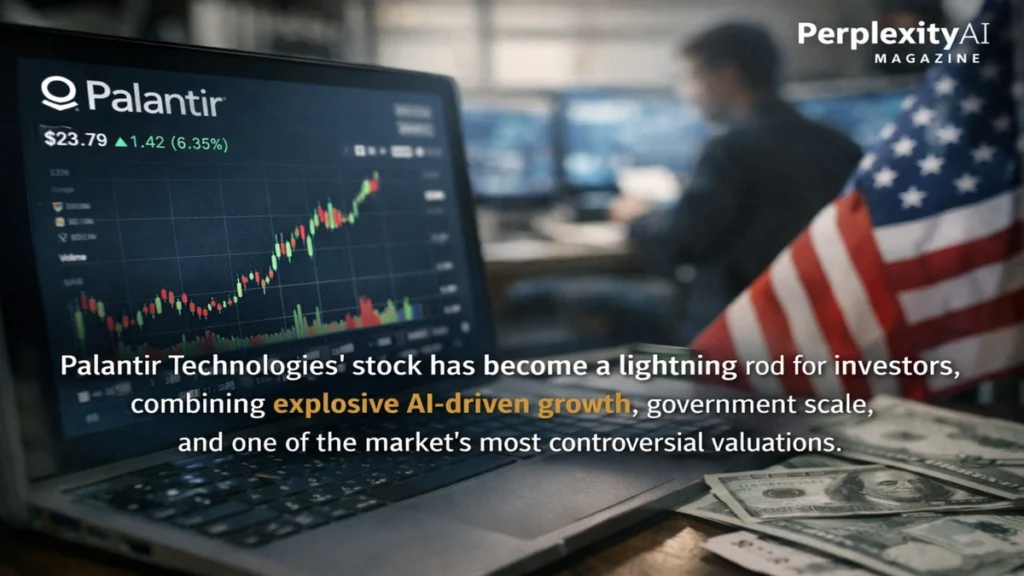
When investors search for “pltr stock,” they are not just checking a price. They are trying to understand how a company once viewed as a niche government contractor became one of the most polarizing artificial intelligence plays in the public markets. As of late January 2026, Palantir Technologies’ shares trade around $149 to $151, sharply below recent highs and far off a 52-week peak above $200. The decline has not cooled debate. If anything, it has intensified it.
At the heart of that debate is a familiar tension. Palantir sits at the intersection of national security, enterprise software, and generative AI, three areas investors believe will define the next decade. At the same time, the stock trades at valuation levels rarely sustained in public markets without disappointment. With a market capitalization north of $340 billion and a price-to-earnings ratio well above 300, PLTR embodies both the promise and peril of AI-era investing.
The search intent behind “pltr stock” reflects this uncertainty. Retail investors want clarity on price direction. Long-term holders want to know whether Palantir’s AI Platform can justify its valuation. Skeptics want to understand how much optimism is already priced in. This article examines Palantir’s business, its technology stack, its growth drivers in 2026, and the risks embedded in its stock price, offering a grounded look at why PLTR inspires such strong conviction on both sides.
Palantir’s Business in Context
Founded in 2003, Palantir Technologies built its reputation supplying data-integration and analytics software to intelligence agencies and defense organizations. For years, this government focus defined the company’s identity and revenue mix. That perception has shifted rapidly. Over the past two years, Palantir has repositioned itself as an AI-native operating system for decision-making across government and commercial sectors.
Palantir’s software does not simply analyze data. It connects disparate datasets, applies models, and embeds outputs directly into workflows. This positioning differentiates Palantir from analytics vendors that stop at dashboards. The company sells outcomes rather than tools, often embedding engineers alongside customers to tailor deployments.
That model has historically limited scale. It also created deep, sticky relationships. In 2024 and 2025, Palantir began translating that stickiness into faster commercial growth by productizing more of its stack and shortening sales cycles. The result is a company that still relies on government credibility while increasingly selling to large enterprises seeking AI-driven operational advantages.
PLTR Stock Price and Valuation Snapshot
Palantir’s valuation sits at the center of every serious discussion about the stock.
PLTR Valuation Overview
| Metric | Approximate Level |
|---|---|
| Share price | $149 to $151 |
| Market capitalization | $341 to $360 billion |
| P/E ratio | 355 to 368 |
| 52-week range | $66 to $208 |
These numbers place Palantir among the most expensive software companies in public markets. Bulls argue that traditional valuation metrics fail to capture Palantir’s long-term potential as an AI platform. Bears counter that even exceptional growth may not justify current multiples.
Market historian Howard Marks has noted that extreme valuations compress future returns even when businesses perform well. That observation frames much of the skepticism around PLTR.
What “PLTR Stock” Signals to Investors
The keyword “pltr stock” is heavily associated with retail investor interest. It often spikes during earnings reports, government contract announcements, or broader AI-sector rallies. Unlike mature software companies, Palantir’s stock trades as much on narrative momentum as on quarterly results.
For traders, PLTR represents volatility. The stock has experienced sharp drawdowns and explosive rallies within the same year. For long-term investors, it represents a bet on Palantir becoming a foundational layer of enterprise AI infrastructure.
This dual identity makes PLTR difficult to categorize. It is not a steady compounder. It is also not a pre-revenue speculation. It occupies an uncomfortable middle ground where expectations are enormous and tolerance for disappointment is low.
Street Sentiment and Forecasts
Analyst sentiment around Palantir remains mixed. Many firms rate the stock a Hold, reflecting discomfort with valuation rather than business quality. Price targets vary widely.
Analyst Scenarios for 2026
| Scenario | Price Range | Rationale |
|---|---|---|
| Bear case | $80 to $100 | Valuation compression, slower growth |
| Base case | $180 to $200 | Sustained AI-driven expansion |
| Bull case | $235 to $380 | Dominant AI platform adoption |
The median target around $190 implies modest upside from current levels. The dispersion of forecasts highlights uncertainty rather than consensus.
AI Platform as a Growth Engine
Palantir’s Artificial Intelligence Platform, known as AIP, has become the company’s defining product. AIP connects large language models to enterprise data in a controlled, auditable environment. It allows organizations to build AI-driven agents that assist with planning, logistics, forecasting, and decision support.
AIP adoption accelerated in 2025, with Palantir reporting hundreds of seven-figure contracts tied directly to the platform. These deals often expand after initial deployment, creating multi-year revenue streams.
Technology analyst Ben Thompson has argued that platforms which integrate AI directly into operational workflows will capture disproportionate value. AIP aligns closely with that thesis.
Commercial Revenue Surge
The most dramatic change in Palantir’s financial profile has come from its U.S. commercial business. In 2025, commercial revenue grew more than 100 percent year over year in several quarters, reaching nearly $400 million in a single quarter.
This growth was driven by a shift in sales strategy. Palantir introduced short, hands-on AIP bootcamps that allowed potential customers to see value within days rather than months. The approach reduced sales friction and accelerated deal sizes.
If this momentum continues into 2026, commercial revenue could rival government revenue within a few years, fundamentally changing Palantir’s narrative.
Government Contracts and Stability
Despite commercial excitement, government remains Palantir’s foundation. Defense and intelligence contracts are typically long-duration, high-margin, and difficult to displace. Analysts expect government revenue growth of 50 to 70 percent in 2026 as pilot programs scale into full deployments.
These contracts provide predictability. They also lend credibility to Palantir’s technology, particularly in high-stakes environments. For investors, government revenue acts as ballast against volatility in commercial cycles.
Operating Leverage and Margins
One of Palantir’s strongest arguments is operating leverage. Revenue has grown rapidly while headcount growth has remained modest. The company has credited AI-assisted development and deployment tools for improving productivity.
Adjusted operating margins in the mid-40 to low-50 percent range position Palantir among the most profitable software firms at scale. If margins remain intact as revenue grows, free cash flow could expand dramatically.
Former software executive and investor Bill Gurley has emphasized that margin durability is often more important than headline growth. Palantir’s margins support the bullish case, even as valuation tempers enthusiasm.
Inside Palantir’s Technology Stack
Palantir’s products form a tightly integrated ecosystem rather than standalone tools.
Core Palantir Platforms
| Platform | Primary Role |
|---|---|
| Apollo | Deployment and infrastructure |
| Foundry | Commercial data operations |
| Gotham | Government and defense operations |
| AIP | AI and agent layer |
Apollo manages deployment across cloud, on-premise, and edge environments. Foundry structures commercial data into a unified ontology. Gotham applies that architecture to defense and intelligence use cases. AIP sits on top, enabling AI-driven automation across both.
This integration makes Palantir difficult to replace once embedded. It also complicates implementation, reinforcing the company’s high-touch model.
Valuation Risk and Market Psychology
Valuation remains PLTR’s greatest risk. At more than 100 times sales and an extreme earnings multiple, the stock leaves little room for execution errors or macro shocks. Even strong results can trigger sell-offs if guidance disappoints.
Market cycles matter. In periods of AI optimism, Palantir trades as a visionary platform. In risk-off environments, it trades as an overvalued software stock. Investors must be comfortable with that swing.
Technical Picture
From a technical perspective, PLTR has recently traded below its 50-day and 200-day moving averages, signaling consolidation or short-term weakness. Momentum traders often view this as cautionary, while long-term investors see potential accumulation zones.
Takeaways
• PLTR combines exceptional growth with extreme valuation
• AIP is the central driver of Palantir’s AI narrative
• Commercial revenue growth has reshaped the business
• Government contracts provide stability and credibility
• Margins and operating leverage strengthen the bull case
• Valuation compression remains the primary downside risk
Conclusion
Palantir Technologies occupies a rare position in public markets. It is simultaneously a mature government contractor and a fast-growing AI platform company. That duality explains both its appeal and its volatility. For believers, PLTR represents a chance to own infrastructure that could define how organizations use AI at scale. For skeptics, it represents a reminder that even great businesses can be poor investments at the wrong price.
As 2026 unfolds, the stock’s trajectory will hinge less on whether Palantir can grow and more on whether it can grow fast enough to justify expectations. In that sense, “pltr stock” is not just a ticker symbol. It is a referendum on how much the market is willing to pay today for an AI-driven future that is still being written.
Frequently Asked Questions
What does Palantir do?
Palantir builds data integration and AI platforms used by governments and enterprises for decision-making and operations.
Why is PLTR stock so expensive?
Investors price in high growth, strong margins, and Palantir’s position in AI-driven analytics.
Is PLTR a good long-term investment?
It depends on risk tolerance. The business is strong, but valuation risk is significant.
What drives Palantir’s growth in 2026?
AIP adoption, commercial expansion, and scaling government contracts.
What is the biggest risk to PLTR stock?
Valuation compression if growth or sentiment disappoints.
