
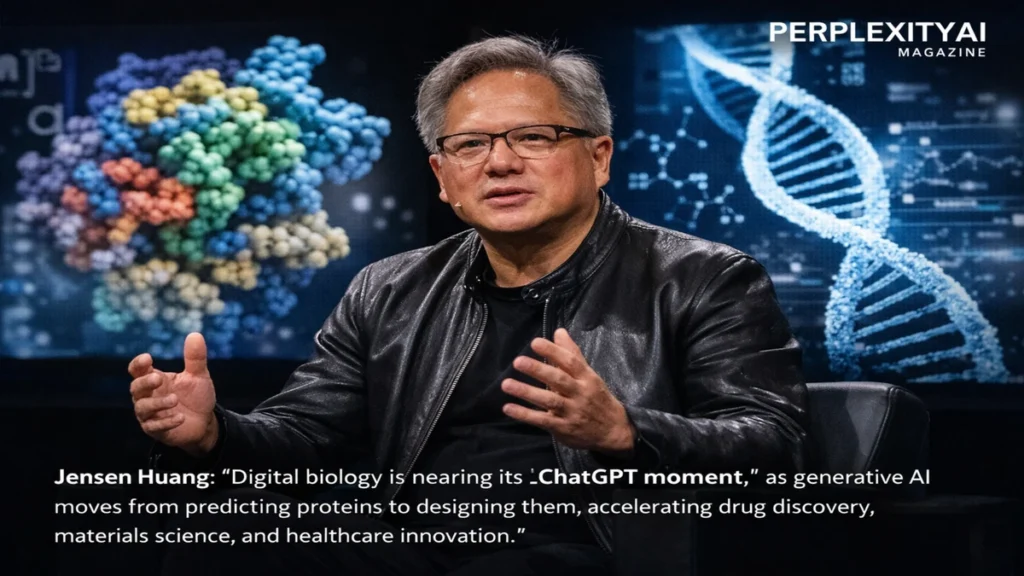
When Jensen Huang says digital biology is approaching its “ChatGPT moment,” he is not reaching for a catchy metaphor. He is describing a threshold. In early 2026, the NVIDIA chief executive argued that biology is on the verge of the same kind of platform shift that transformed language, coding, and knowledge work when large generative models became widely usable. In the first hundred words, the implication is clear: artificial intelligence is no longer just assisting biologists. It is beginning to act as a creative engine for biology itself.
For decades, drug discovery and protein science have moved slowly, constrained by laboratory cycles, incomplete data, and the sheer complexity of living systems. Even with modern computing, progress often meant years of incremental advances and billions of dollars in investment before a single drug reached patients. Huang’s claim is that this paradigm is breaking. Generative AI models, trained on massive biological datasets and powered by accelerated computing, are learning the “grammar” of proteins, cells, and molecular interactions.
This matters beyond the laboratory. Faster discovery means earlier therapies, lower costs, and a new relationship between computation and medicine. It also means biology is becoming programmable in ways that echo software engineering. As AI models move from understanding single proteins to modeling multi-protein systems and cellular behavior, they create a feedback loop where data, models, and experiments continuously reinforce one another.
The following article examines why Huang’s statement resonates now, how generative biology differs from earlier computational approaches, and what this transformation could mean for healthcare, biotechnology, and society.
From Prediction to Creation in Biological AI
The first wave of artificial intelligence in biology focused on prediction. Models were trained to recognize patterns in sequences and structures, offering faster ways to infer how proteins fold or how molecules might bind. These tools were powerful, but they largely answered questions humans already knew how to ask. They accelerated existing workflows rather than redefining them.
The shift Huang describes is different. Generative biological models do not merely predict outcomes from known inputs. They generate new possibilities. By learning from vast datasets of protein sequences, structures, and interactions, these systems can propose entirely new proteins, antibodies, or molecular compounds that have never existed before. This mirrors the jump from autocomplete systems to large language models capable of writing essays, code, and dialogue.
What makes this moment possible is scale. Biological data has grown exponentially, from genomic sequencing to proteomics and multi-omics datasets. At the same time, advances in accelerated computing allow models to process long contexts and multiple data modalities at once. The result is an AI system that can reason across sequences, structures, functions, and environments, rather than treating each in isolation.
This transition from prediction to creation reframes biology as an engineering discipline. Instead of testing thousands of random variations in the lab, researchers can explore millions of virtual designs in silico, narrowing the field before physical experiments begin. The creative step moves upstream, into computation.
Read: Apple AI News 2026: Xcode, Privacy, On-Device Intelligence
The Meaning of a “ChatGPT Moment” for Biology
A “ChatGPT moment” is not just about technical capability. It is about accessibility and workflow change. When generative language models reached a certain level of fluency, they escaped the lab and entered everyday use. Developers, writers, and analysts suddenly had a new interface to intelligence.
In digital biology, a similar inflection point would mean that designing proteins or exploring molecular interactions becomes as interactive as prompting a model. Scientists would guide AI systems with constraints and objectives, rather than manually enumerating hypotheses. The work becomes conversational and iterative, compressing cycles that once took months.
Huang’s framing also emphasizes foundation models. Just as a single language model can support translation, coding, and reasoning, a biological foundation model can underpin multiple tasks: protein design, target identification, toxicity prediction, and pathway analysis. Once trained, such models become platforms on which entire ecosystems of tools and applications can be built.
The comparison highlights another parallel: trust. Language models forced society to grapple with reliability, bias, and accountability. Biological models will raise similar concerns, but with higher stakes. When AI proposes a protein that could become a drug, the cost of error is not a hallucinated sentence but a failed clinical trial or a safety risk.
Multi-Protein Systems and the Next Complexity Layer
Early successes in AI biology often focused on single proteins. Predicting how one sequence folds into a three-dimensional structure was a breakthrough, but biology rarely operates in isolation. Most diseases emerge from networks of interacting proteins, signaling pathways, and cellular environments.
The next phase, which Huang highlighted, involves modeling multi-protein systems and even whole-cell behavior. This requires AI systems that can handle long contexts and multiple modalities, integrating genetic data, expression levels, spatial organization, and temporal dynamics. It is an order of magnitude more complex than single-protein prediction. – chatgpt moment.
Generative models are uniquely suited to this challenge because they can represent probability distributions over vast spaces. Instead of trying to compute every interaction explicitly, they learn the statistical relationships that govern biological systems. This allows them to simulate how changes in one protein might ripple through a network, affecting downstream behavior.
If successful, this approach could unlock so-called undruggable targets, pathways previously considered too complex or indirect to manipulate. By understanding systems rather than components, AI may enable therapies that modulate networks rather than single molecules.
Accelerating Drug Discovery Timelines
One of the most tangible promises of generative biology is speed. Traditional drug discovery often spans 10 to 15 years from target identification to market approval. Much of that time is spent in early discovery phases, where researchers search for viable targets and optimize candidate molecules.
AI foundation models compress these stages. Protein structure prediction that once took months and significant expense can now be performed in minutes. Virtual screening of billions of compounds replaces slower, more expensive wet-lab assays. Generative design tools propose optimized molecules that balance potency, stability, and safety before a single synthesis step.
The result is not the elimination of laboratories but their amplification. Experimental work becomes more focused and informed. Early-stage research cycles shorten by 30 percent or more, according to industry estimates, allowing teams to pursue more ideas in parallel and abandon weak candidates earlier.
This acceleration does not guarantee success in clinical trials, but it shifts the economics of discovery. Lower upfront costs and faster iteration reduce risk, potentially enabling smaller firms and academic groups to compete with large pharmaceutical companies.
NVIDIA’s Role and the BioNeMo Platform
NVIDIA’s influence in this transformation lies in infrastructure. The company’s BioNeMo platform is designed to support end-to-end biological AI workflows, from model training to deployment. It provides tools for handling large biological datasets, optimizing models for accelerated hardware, and integrating AI outputs into research pipelines.
BioNeMo reflects Huang’s broader vision of full-stack AI platforms. Instead of offering isolated algorithms, NVIDIA positions itself as a provider of the computing foundation on which biological innovation runs. This includes GPUs optimized for AI workloads, software frameworks for model development, and partnerships that connect computation with domain expertise.
The significance of this approach is strategic. By standardizing the infrastructure layer, NVIDIA enables a diverse ecosystem of biotech firms, research institutions, and pharmaceutical companies to build on shared tools. This mirrors how cloud computing standardized infrastructure for software startups, catalyzing rapid innovation.
Industry Partnerships and Real-World Validation
The credibility of generative biology depends on real-world results. Industry partnerships provide early signals. Collaborations between AI platform providers and pharmaceutical companies aim to translate computational advances into clinical candidates.
Examples include AI-designed antibodies and small molecules entering preclinical and early clinical stages, particularly in oncology and immunology. These efforts demonstrate that generative models can produce viable biological entities, not just theoretical designs.
Such partnerships also highlight a cultural shift. Pharmaceutical research teams increasingly include machine learning engineers alongside chemists and biologists. Decision-making becomes data-driven earlier in the process, with AI-generated insights shaping experimental priorities.
This convergence of disciplines is itself a marker of a platform shift. Biology is no longer separate from computation; it is becoming inseparable from it.
Data Flywheels and Continuous Improvement
A recurring theme in Huang’s comments is the idea of a data flywheel. In this model, every experiment feeds data back into AI systems, improving their performance and guiding subsequent experiments. The loop accelerates as models become more accurate and experiments more targeted.
This dynamic contrasts with traditional research, where data often remains siloed and underutilized. Generative models thrive on scale and diversity, making them well suited to integrate multi-omics data, clinical outcomes, and real-world evidence.
As flywheels spin faster, discovery becomes cumulative rather than episodic. Insights gained in one disease area may inform another. Models trained on protein interactions in oncology could contribute to immunology or metabolic research, creating cross-domain leverage.
Implications for Healthcare Integration
The impact of generative biology extends beyond drug discovery into healthcare systems. AI models that understand molecular mechanisms can be linked with clinical data to improve precision medicine. Biomarker discovery becomes faster and more robust, enabling better patient stratification and treatment selection.
Integration with electronic health records allows researchers to correlate molecular patterns with outcomes at scale. This could shorten the feedback loop between bench and bedside, ensuring that discoveries reflect real patient populations rather than narrow experimental models.
For healthcare providers, the promise is more targeted therapies and fewer trial-and-error treatments. For patients, it could mean earlier access to effective drugs and a shift toward preventive, personalized care.
Ethical, Regulatory, and Social Considerations
With power comes responsibility. Generative biology raises ethical and regulatory questions that extend beyond those faced by language models. Designing biological entities touches on safety, consent, and the potential for misuse.
Regulators must adapt frameworks designed for incremental innovation to assess AI-generated designs. Transparency in model training, validation, and decision-making will be critical. So will rigorous experimental verification, ensuring that computational confidence does not outpace empirical evidence.
There are also social considerations. If AI dramatically lowers the cost of discovery, who benefits? Ensuring equitable access to resulting therapies will be as important as the technology itself. The “ChatGPT moment” in biology should not widen existing health disparities.
Expert Perspectives on the Transformation
Industry leaders frame this moment as a turning point. Executives and researchers emphasize that AI is not replacing human judgment but augmenting it. The most optimistic visions see scientists freed from routine tasks, able to focus on creativity, interpretation, and ethical oversight.
At the same time, there is caution. Biology is messy, and models trained on incomplete or biased data can mislead. The consensus among experts is that generative AI will be most powerful when paired with domain expertise and rigorous validation.
These perspectives underscore that the transformation is as much cultural as technical. Organizations must learn to trust AI without surrendering responsibility.
Takeaways
- Digital biology is approaching a platform shift similar to the rise of generative language models.
- Generative AI moves biology from prediction to creation, enabling novel protein and molecule design.
- Accelerated discovery timelines could reduce early-stage drug development by years.
- Foundation models and data flywheels create cumulative, cross-domain innovation.
- Healthcare integration promises more precise, personalized therapies.
- Ethical and regulatory adaptation will shape how responsibly this power is used.
Conclusion
Jensen Huang’s assertion that digital biology is nearing its “ChatGPT moment” captures a convergence of data, compute, and ambition. Generative AI is transforming how scientists interact with biology, turning discovery into an iterative, computational process rather than a slow sequence of isolated experiments.
The promise is immense: faster therapies, deeper understanding of disease, and a reimagining of biology as an engineering discipline. Yet the challenges are equally significant. Safety, equity, and governance will determine whether this transformation fulfills its potential or falters under its own complexity.
As with previous platform shifts, the true impact will unfold over years, not months. But the direction is clear. Biology is becoming digital, generative, and increasingly programmable. If this is indeed a ChatGPT moment, it may mark the beginning of a new era in how humanity understands and shapes life itself.
FAQs
What is meant by a “ChatGPT moment” in digital biology?
It refers to a tipping point where generative AI becomes powerful and accessible enough to transform biological research workflows, similar to how ChatGPT transformed language-based tasks.
How does generative AI differ from earlier biological AI tools?
Earlier tools focused on prediction. Generative AI creates new proteins or molecules, exploring biological possibilities rather than just analyzing existing data.
Why is protein generation so important for drug discovery?
Proteins are central to disease mechanisms. Designing them faster enables quicker identification of therapeutic targets and candidates.
Will AI replace biologists and chemists?
No. AI augments human expertise by accelerating analysis and design, while humans provide interpretation, creativity, and ethical judgment.
What are the biggest risks of generative biology?
Risks include safety concerns, biased data, regulatory gaps, and unequal access to resulting therapies.
