
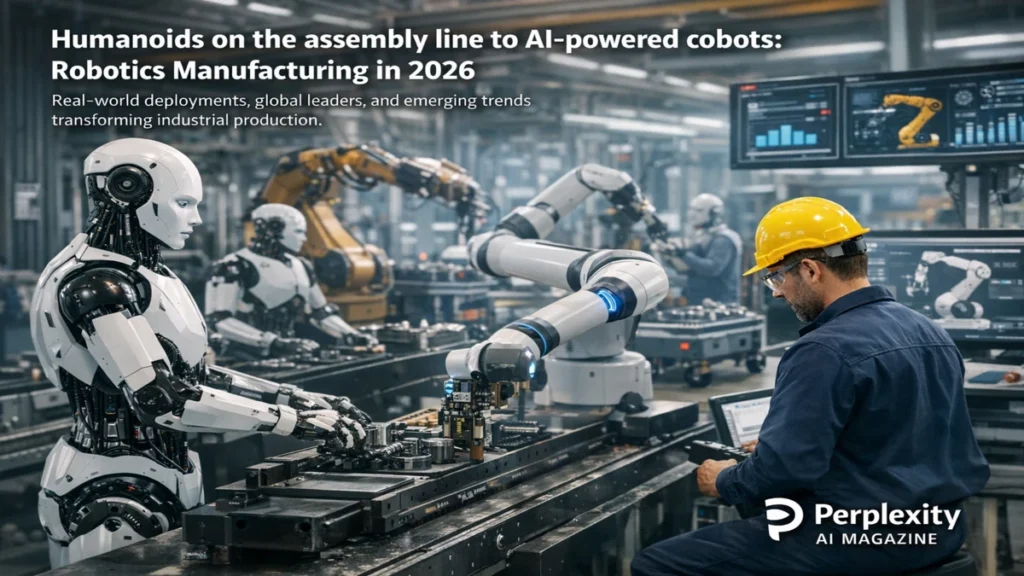
Robotics manufacturing news in early 2026 points to a decisive shift in how factories are designed, staffed, and operated. Across automotive plants, electronics facilities, warehouses, and heavy industry, robots are no longer treated as fixed assets programmed once and left unchanged for years. Instead, they are evolving into adaptive systems, guided by artificial intelligence, capable of learning, collaborating, and scaling with production needs. For manufacturers facing labor shortages, rising costs, and geopolitical pressure to reshore production, robotics has moved from long-term investment to near-term necessity.
In the first months of 2026, announcements from major manufacturers and robotics companies underscored this transition. Humanoid robots, once confined to research labs and marketing demos, are now being positioned as practical solutions for repetitive, high-risk, and ergonomically challenging tasks. At the same time, collaborative robots and autonomous mobile systems are spreading across factory floors, driven by advances in sensing, AI-driven control, and real-time decision-making at the edge.
This wave of change is also reflected in rising interest around the keyword “robotics manufacturing news,” which has gained traction among industry professionals, engineers, and investors tracking the transformation of industrial automation. The focus has shifted away from raw robot counts toward questions of total cost of ownership, deployment speed, and flexibility. In 2026, the defining issue is not whether robots can perform a task, but how quickly they can be deployed, reconfigured, and integrated into existing operations.
This article examines the dominant trends shaping robotics manufacturing in 2026, from humanoid deployments and AI integration to regional adoption patterns and the growing role of human-robot collaboration. It draws exclusively on the developments and context outlined above, presenting a clear, grounded view of how robotics is reshaping manufacturing today.
Humanoid Robots Move Into Production
One of the most striking themes in robotics manufacturing news this year is the transition of humanoid robots from experimental platforms to production-ready systems. Humanoids are being positioned not as replacements for traditional industrial robots, but as complements designed to operate in environments built for humans. Their value lies in flexibility: the ability to navigate existing factory layouts, use standard tools, and perform tasks that require human-like reach and dexterity.
In 2026, several major manufacturers signaled their intent to deploy humanoids at scale. Production-ready humanoid systems are being designed for tasks such as parts handling, machine tending, inspection, and material transport. These are areas where traditional automation struggles due to variability or the need for frequent reconfiguration.
A key differentiator of this new generation of humanoids is their reliance on edge AI for real-time autonomy. Instead of relying on constant cloud connectivity, these robots process sensor data locally, enabling fast reactions to changes in their environment. This capability is essential for safety and reliability on busy factory floors, where milliseconds can make the difference between smooth operation and costly downtime.
The emphasis in 2026 is not spectacle, but practicality. Manufacturers evaluating humanoids are focused on deployment timelines, maintenance requirements, and integration with existing systems. The shift suggests that humanoids are entering factories not as experimental novelties, but as serious tools for addressing structural labor and productivity challenges.
Read: Edge AI News 2026: Real-Time Intelligence Moves to Devices
AI as the Operating System of Modern Factories
Artificial intelligence has become the central operating layer of modern robotics manufacturing. Rather than simply executing predefined paths, robots increasingly rely on AI to perceive their surroundings, plan actions, and adapt to variation. This is especially evident in factories producing high-mix, low-volume goods, where rigid automation has historically struggled.
AI-driven motion planning allows robots to adjust trajectories in real time, accommodating changes in part position or orientation without manual reprogramming. Voice and natural language interfaces enable technicians to issue commands or corrections without specialized coding skills, reducing training barriers and speeding up deployment. Reinforcement learning techniques allow robots to refine their actions based on feedback, improving performance over time.
Another critical component of AI integration is the use of digital twins. Virtual replicas of factory environments allow engineers to simulate robot behavior, test workflows, and identify bottlenecks before physical deployment. This approach reduces commissioning time and minimizes the risk of costly errors during installation. In 2026, digital twins are increasingly paired with live production data, creating feedback loops that continuously optimize operations.
For manufacturers, the practical benefit of AI integration is improved total cost of ownership. Faster deployment, reduced downtime, and lower reprogramming costs all contribute to a stronger business case for robotics, particularly in environments where demand fluctuates and flexibility is essential.
Edge AI and Real-Time Control
Edge AI plays a foundational role in the current wave of robotics manufacturing innovation. By processing data locally on the robot or nearby controllers, edge AI enables real-time control that is not dependent on network latency or cloud availability. This capability is especially important in manufacturing settings, where safety, precision, and reliability are paramount.
Robots equipped with edge AI can respond instantly to sensor input, whether it comes from vision systems, force sensors, or tactile feedback. This allows for smooth human-robot collaboration, collision avoidance, and adaptive task execution. In contrast, cloud-based inference, while powerful, introduces delays that are unacceptable for time-critical operations.
The rise of edge AI also supports scalability. As manufacturers deploy fleets of robots across multiple sites, reducing dependence on centralized compute infrastructure lowers operational complexity and ongoing costs. Updates and high-level analytics can still be managed through the cloud, but day-to-day decision-making happens at the edge.
In 2026, edge AI is not viewed as an experimental feature but as a baseline requirement for advanced manufacturing robots, particularly humanoids and collaborative systems designed to operate alongside people.
Collaborative Robots and Human-Robot Collaboration
Collaborative robots, or cobots, continue to gain momentum in manufacturing environments that demand flexibility and close human interaction. Unlike traditional industrial robots, cobots are designed to share workspaces with humans, relying on advanced sensing and control to ensure safety.
Recent advances have focused on multimodal perception, combining vision, depth sensing, and force feedback to create a detailed understanding of the workspace. This sensor fusion allows cobots to anticipate human movement, adjust speed, and apply force limits that prevent injury. Latency below critical thresholds ensures that safety responses are immediate and reliable.
Human-robot collaboration has also become more intuitive. Natural language interfaces allow operators to guide robots using voice commands, even in noisy industrial settings. Demonstration-based learning enables workers to teach new tasks by example, reducing the need for specialized programming and cutting setup time.
Manufacturers adopting cobots report gains in productivity and worker satisfaction. By offloading repetitive or physically demanding tasks to robots, companies can reduce strain injuries and allow human workers to focus on supervision, problem-solving, and quality control. In 2026, this human-centric approach aligns closely with broader Industry 5.0 principles.
Scalable Automation and Total Cost of Ownership
A recurring theme in robotics manufacturing news is the shift from upfront cost considerations to total cost of ownership. As robotics systems become more capable and flexible, manufacturers are evaluating them over multi-year horizons rather than as one-time capital expenditures.
Scalable automation systems are designed to grow with production needs. Modular robot cells, autonomous mobile robots, and reconfigurable workstations allow factories to add capacity incrementally. This approach reduces risk and aligns investment with demand.
AI-driven adaptability further improves economics by reducing engineering effort. Robots that can be redeployed across tasks or product lines without extensive reprogramming deliver greater long-term value. Maintenance strategies are also evolving, with predictive diagnostics identifying issues before they cause downtime.
In this context, robotics manufacturing decisions in 2026 are increasingly strategic. Companies are not just buying robots; they are investing in platforms that support continuous improvement and resilience in the face of market uncertainty.
Global Adoption Patterns
Robotics manufacturing news consistently highlights differences in adoption across regions. Asia-Pacific remains the global leader, driven by large-scale manufacturing capacity, strong government support, and deep robotics ecosystems. China, Japan, and South Korea continue to install robots at scale across automotive, electronics, and logistics sectors.
India is emerging as a significant growth market, particularly for autonomous mobile robots and collaborative systems supporting expanding manufacturing hubs. In North America, robotics adoption is closely tied to reshoring initiatives and the need to address labor shortages in automotive and warehousing operations. European manufacturers often emphasize safety, sustainability, and human-centric automation, influencing the design and deployment of robotics systems.
Despite these differences, a common thread unites global adoption: the need for flexible, intelligent automation that can adapt to changing conditions. Robotics manufacturing news in 2026 reflects this convergence, even as regional priorities shape specific implementations.
Timeline of Key Developments
| Period | Development | Impact |
|---|---|---|
| Early 2026 | Production-ready humanoid robots announced | Signals readiness for factory deployment |
| Early 2026 | AI-driven digital twins gain adoption | Reduces commissioning time and risk |
| 2026 | Expansion of cobot deployments | Enhances human-robot collaboration |
| 2026 | Growth in edge AI adoption | Enables real-time autonomy and safety |
These developments collectively define the current phase of robotics manufacturing, emphasizing readiness, scalability, and integration.
Industry Perspectives
Industry experts consistently frame the current moment as a turning point rather than a gradual evolution. One manufacturing strategist notes that AI-driven robotics is now central to factory resilience, enabling rapid adaptation to demand shifts. Another robotics engineer emphasizes that humanoids are being judged not by novelty but by uptime, maintainability, and return on investment.
A third perspective highlights the cultural shift on factory floors, where workers increasingly view robots as collaborative tools rather than threats. This acceptance, driven by safer designs and clearer productivity benefits, is accelerating adoption across sectors.
Takeaways
- Humanoid robots are entering factories as practical tools, not experiments.
- AI integration enables adaptability, faster deployment, and lower long-term costs.
- Edge AI is essential for real-time control and safety in manufacturing environments.
- Collaborative robots support human-centric automation and reduce physical strain.
- Total cost of ownership now outweighs upfront price in robotics decisions.
- Asia-Pacific leads adoption, but global convergence is underway.
Conclusion
Robotics manufacturing in 2026 stands at a crossroads between ambition and execution. The technologies driving today’s headlines—humanoids, AI-driven control, digital twins, and collaborative systems—are no longer confined to pilot projects. They are being integrated into real production environments, reshaping how factories operate and how work is organized.
The defining characteristic of this moment is pragmatism. Manufacturers are adopting robotics not to chase novelty, but to solve concrete problems: labor shortages, safety risks, and the need for flexibility in uncertain markets. Edge AI and scalable automation platforms allow robots to operate with greater autonomy and reliability, while human-robot collaboration ensures that people remain central to production.
As robotics manufacturing news continues to evolve through 2026, the focus will remain on measurable impact. The factories that succeed will be those that treat robotics as a living system—continuously improved, intelligently managed, and deeply integrated into the fabric of industrial work.
FAQs
What is driving robotics manufacturing growth in 2026?
Labor shortages, reshoring efforts, and advances in AI and edge computing are accelerating adoption.
Are humanoid robots actually being used in factories?
Yes. In 2026, production-ready humanoids are being deployed for repetitive and high-risk tasks.
How does AI improve manufacturing robots?
AI enables perception, adaptation, and learning, reducing reprogramming and increasing flexibility.
What role does edge AI play in robotics?
Edge AI allows real-time decision-making and safety responses without relying on cloud latency.
Why are collaborative robots gaining popularity?
Cobots improve productivity while allowing safe, intuitive interaction with human workers.
