
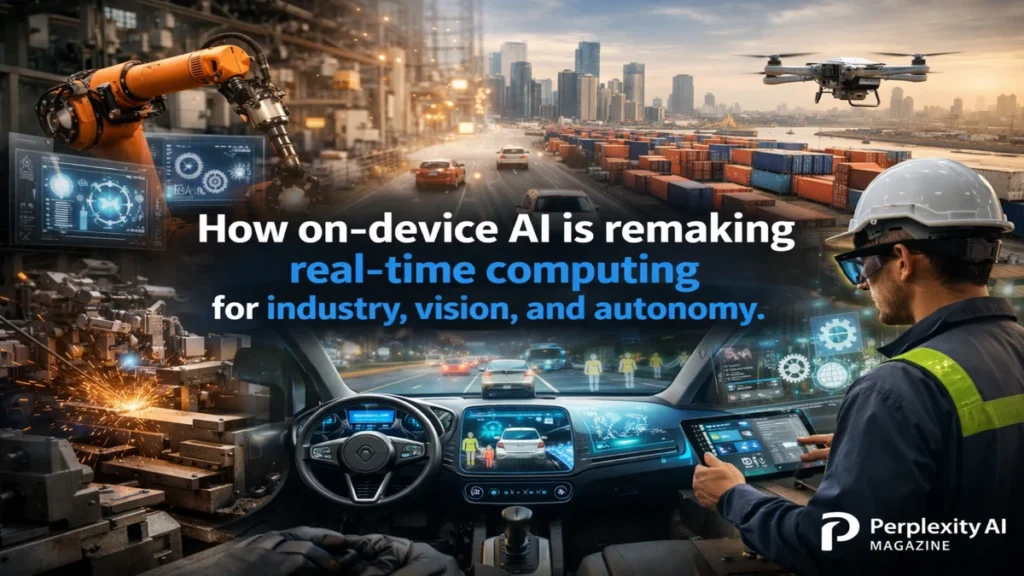
Edge AI has become one of the most consequential shifts in artificial intelligence deployment as 2026 unfolds. Instead of sending data to distant cloud servers, edge AI runs models directly on devices—cameras, sensors, robots, vehicles, and microcontrollers—where decisions must be made instantly. In industrial operations, vision systems, healthcare monitoring, and autonomous machines, milliseconds matter. Edge AI exists to eliminate that delay. – edge ai news.
Within the first months of 2026, discussion around edge AI news has coalesced around three ideas: ultra-low latency inference, privacy-preserving computation, and the practical limits of hardware-constrained intelligence. Unlike large cloud models optimized for scale, edge models are compressed, specialized, and engineered to run on limited memory and power budgets. That constraint is not a weakness; it is the reason edge AI works where cloud systems cannot.
For content creators and analysts, “edge AI news” has emerged as a niche but valuable keyword. Semrush keyword analysis shows that specialized technology terms like this tend to attract targeted audiences with moderate competition, making them attractive for technical publications tracking long-term trends rather than hype cycles. Interest reflects a broader industry realization: intelligence is migrating closer to the physical world.
This article examines the current state of edge AI using established developments already outlined, including AI-enabled microcontrollers, embedded 3D sensing, and industrial deployment. It compares edge AI with cloud inference, explores startup momentum, and assesses how factories, vehicles, and retail environments are being reshaped. The goal is not prediction for prediction’s sake, but clarity about why edge AI now matters and where it is already delivering results.
What Edge AI Means in Practice
Edge AI refers to running artificial intelligence models locally on hardware devices rather than relying on centralized cloud servers. In practice, this means inference happens where data is generated: inside a camera, inside a machine controller, or inside a wearable device. The benefit is immediate responsiveness without dependence on network connectivity.
This local execution model enables systems to operate even when offline, a requirement in many industrial and safety-critical environments. It also reduces the volume of data transmitted across networks, lowering operational costs and minimizing exposure of sensitive information. For regulated sectors such as healthcare or manufacturing, keeping data on-device simplifies compliance and risk management. – edge ai news.
Edge AI is not about replacing the cloud. Instead, it complements cloud infrastructure by handling time-critical decisions locally while relying on centralized systems for model training, fleet management, and long-term analytics. This hybrid approach has become the dominant architectural pattern across edge deployments.
Read: LLM News 2026: Safety, Scale, and the Next Phase
Edge AI Versus Cloud Inference
Understanding edge AI requires comparing it directly with cloud-based inference. Each paradigm has strengths and limitations that determine where it fits best.
| Aspect | Edge AI | Cloud Inference |
|---|---|---|
| Latency | Milliseconds, no network delay | Network-dependent, often 100 ms or more |
| Scalability | Limited by device hardware | Elastic, scalable on demand |
| Cost Structure | Higher upfront hardware, lower long-term operating cost | Ongoing usage-based fees |
| Privacy | Data remains local | Data transmitted to remote servers |
| Compute Capacity | Constrained, optimized models | Massive compute for large models |
| Connectivity | Can function offline | Requires stable internet |
Edge AI excels where speed, determinism, and autonomy are essential. Cloud inference remains dominant for complex analytics, large generative workloads, and centralized coordination. Increasingly, organizations combine both: edge devices handle real-time inference, while the cloud manages learning, updates, and orchestration.
Microcontrollers and the Rise of TinyML
One of the most important technical developments highlighted in recent edge AI discussions is the expansion of AI into microcontrollers. Traditionally, microcontrollers executed fixed logic with minimal memory and compute. Advances in model compression, quantization, and tooling have changed that reality.
TinyML enables machine learning inference on microcontrollers measured in kilobytes rather than gigabytes. These systems can perform speech recognition, vibration analysis, and simple vision tasks using only milliwatts of power. AI-enabled microcontrollers are now being deployed in sensors embedded in factories, infrastructure, and consumer devices. – edge ai news.
This shift dramatically expands the addressable market for edge AI. Intelligence is no longer limited to high-end devices with dedicated accelerators. Instead, it becomes a baseline capability across everyday electronics, enabling predictive maintenance, anomaly detection, and adaptive control at scale.
Embedded Vision and 3D Sensing
Vision systems have become a cornerstone of edge AI adoption. Cameras generate enormous volumes of data, making local inference essential for efficiency and responsiveness. Recent recognition of single-camera 3D sensing solutions illustrates how perception is evolving beyond traditional stereo systems.
Embedded depth perception allows machines to understand spatial relationships in real time, a requirement for advanced driver assistance systems, robotics navigation, and industrial inspection. By processing visual data locally, edge AI systems avoid bandwidth bottlenecks and deliver immediate feedback. – edge ai news.
The convergence of vision, depth sensing, and AI at the edge is redefining how machines interact with the physical world. These systems no longer just see; they interpret, decide, and act without human intervention.
Industrial Transformation at the Edge
Factories have become one of the most mature proving grounds for edge AI. Manufacturing environments demand deterministic behavior, low latency, and resilience to connectivity disruptions. Edge AI meets those requirements by embedding intelligence directly into production lines.
Use cases include defect detection, predictive maintenance, worker safety monitoring, and robotic coordination. By analyzing sensor and vision data locally, systems can stop machinery, reroute workflows, or flag anomalies instantly. Over time, this reduces downtime, improves yield, and lowers operational costs. – edge ai news.
Retail environments are following a similar path. Edge AI enables cashier-less checkout, inventory tracking, and real-time customer analytics without sending continuous video streams to the cloud. The result is faster response and reduced infrastructure expense.
Sensor Fusion and Autonomous Systems
Edge AI increasingly operates at the center of sensor fusion, combining data from radar, depth sensors, cameras, and inertial units. Autonomous vehicles, drones, and robots rely on this fusion to build an accurate understanding of their surroundings.
Local inference is essential because delays can be dangerous. An autonomous system cannot wait for a cloud response to avoid a collision or stabilize flight. Edge AI allows these machines to react instantly while maintaining awareness even in disconnected environments. – edge ai news.
Market projections indicate strong growth for systems combining edge AI with advanced sensing technologies. As costs decline and capabilities expand, these systems are moving from specialized deployments into mainstream applications.
Startup Momentum and Innovation
A growing ecosystem of startups is accelerating edge AI adoption by focusing on narrow, high-value problems. These companies build tools and platforms optimized for constrained hardware and real-world deployment.
| Company | Focus Area | Core Contribution |
|---|---|---|
| ClearSpot.ai | Drone-based industrial inspection | Real-time anomaly detection at the edge |
| Nexa AI | On-device generative inference | Local text, image, and speech processing |
| Edge Impulse | Embedded ML development | Tooling for tinyML and IoT deployment |
| Latent AI | Edge-optimized ML platforms | Scalable deployment for constrained systems |
| Skydio | Autonomous drones | Navigation and autonomy using edge compute |
Investment interest reflects confidence that edge AI solves tangible problems rather than speculative ones. These companies operate in sectors where latency, privacy, and autonomy directly translate into economic value.
Expert Perspectives on Edge AI
Industry experts consistently emphasize that edge AI is driven by necessity rather than fashion.
“Edge computing is no longer about sending less data to the cloud,” one robotics expert observed. “It is about enabling autonomous, real-time decisions where delay is unacceptable.”
Another industry leader noted that privacy and latency now dominate enterprise evaluations of AI systems. Organizations increasingly view local inference as a strategic asset rather than a technical optimization.
A third executive highlighted economics, arguing that removing continuous cloud dependency fundamentally changes the cost structure of large-scale deployments. – edge ai news.
Together, these perspectives underscore that edge AI adoption is rooted in operational reality.
Takeaways
- Edge AI enables real-time inference directly on devices without cloud latency.
- Hybrid edge-cloud architectures balance speed with scalability.
- Microcontrollers and tinyML expand AI into power-constrained environments.
- Embedded vision and 3D sensing drive perception at the edge.
- Industrial and retail systems benefit from deterministic local decisions.
- Startups are accelerating innovation through focused edge solutions.
Conclusion
Edge AI in 2026 is no longer an emerging concept; it is an operational strategy shaping how intelligence interacts with the physical world. By relocating inference from centralized servers to devices themselves, organizations gain speed, resilience, and control. The tradeoff is constraint, but constraint has proven to be a catalyst for innovation rather than a limitation.
As hardware improves and tooling matures, edge AI will continue to expand into environments once considered inhospitable to machine intelligence. The future is not edge or cloud, but a deliberate integration of both. What distinguishes successful deployments is clarity about where decisions must be made and how quickly they must occur.
In that sense, edge AI is less about technology trends and more about alignment with reality. Machines that see, hear, and decide locally are becoming the foundation of modern industry. The news surrounding edge AI reflects that shift, not as speculation, but as evidence of systems already at work.
FAQs
What is edge AI?
Edge AI refers to running AI inference directly on devices rather than in the cloud, enabling faster response and local data processing.
Why is edge AI important for industry?
Industrial systems require instant decisions and reliability even without connectivity, making edge inference essential.
Does edge AI replace cloud AI?
No. Edge AI complements cloud AI. Most systems use edge inference with cloud-based training and management.
What is tinyML?
TinyML is machine learning optimized for microcontrollers and low-power devices with limited memory.
Which sectors benefit most from edge AI?
Manufacturing, autonomous systems, healthcare monitoring, retail automation, and security benefit significantly.
