
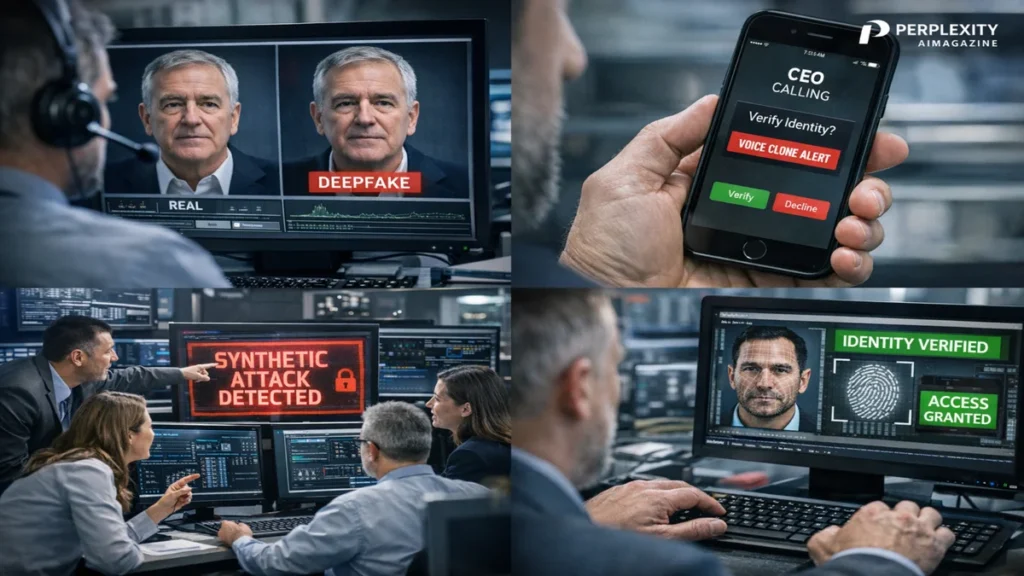
In early 2026, deepfakes stopped being a novelty and became infrastructure. What began as viral face swaps and novelty audio clips has hardened into a global criminal supply chain, offering “Deepfake-as-a-Service” to anyone with a credit card and a grievance. Voice deepfakes alone surged by roughly 680 percent year over year in 2024, according to multiple security vendors, and fraud losses tied to synthetic media have climbed sharply since. By the start of 2026, banks, call centers, newsrooms, and public agencies were no longer asking whether deepfakes would affect them, but how quickly. – deepfake detection news.
The response has been equally consequential. Detection has shifted from static checks to live, layered defenses that blend liveness testing, behavioral biometrics, device fingerprinting, and real-time risk scoring. Events like the UK’s Deepfake Detection Challenge LIVE ’26 have moved evaluation out of academic benchmarks and into adversarial, real-world conditions. At the same time, enterprises are discovering the limits of single-tool defenses: accuracy rates advertised at 98 percent fall quickly when models face new generators, accents, codecs, or multimodal attacks.
This article examines the state of deepfake detection in early 2026: the threats driving adoption, the technologies reshaping defenses, the tools leading the market, and the enterprise frameworks emerging to manage risk. It explains why detection alone is insufficient, why layered verification now defines best practice, and why trust in digital identity may be the most fragile asset of the decade.
The Rise of Deepfake-as-a-Service
Deepfake-as-a-Service, or DaaS, transformed the threat landscape in 2025. Instead of bespoke attacks crafted by skilled operators, DaaS platforms commoditized biometric spoofing, voice cloning, and face synthesis. Attackers could upload a few minutes of audio or a handful of photos and receive usable fakes in minutes. The effect was scale. Social engineering campaigns that once targeted executives now reached payroll clerks, customer support agents, and journalists. – deepfake detection news.
Security leaders warn that 2026 marks the first year of industrialized deepfake fraud. Financial institutions report coordinated voice attacks against call centers, while enterprises see synthetic video used to bypass onboarding checks. Analysts predict that by the end of 2026, nearly 30 percent of organizations will express reduced confidence in standard identity verification because of deepfake exposure. “The economics flipped,” says a fraud strategist at a multinational bank. “Attackers can iterate faster than defenders if you rely on one signal.”
Read: AI for Medical Records and Imaging: Claude, OpenAI, Google
Why Traditional Detection Is Failing
Early deepfake detectors focused on visual artifacts: unnatural blinking, warped edges, or compression errors. Those signals are increasingly unreliable. Modern generators learn from detection research, closing gaps as quickly as they are published. Audio attacks present an even harder problem. Accents, background noise, and phone compression can defeat spectrum-based checks, while short utterances reduce confidence.
Tools like BioID and Deepware report high accuracy in controlled tests, yet real-world performance drops as attackers adapt. “Accuracy numbers without context are misleading,” notes a university researcher studying synthetic media. “What matters is robustness under novelty—new voices, new faces, new generators.”
Detection Advances in 2026
Detection in 2026 is less about a single verdict and more about probability across layers. Liveness detection now uses 3D depth sensing and challenge-response gestures to verify presence. Voice defenses analyze spectral features alongside cadence, micro-pauses, and emotional variance. Behavioral biometrics—how a person types, moves, or responds—add context that generators struggle to replicate consistently.
Device fingerprinting has also emerged as a quiet workhorse. By correlating hardware signals, network paths, and session behavior, platforms can flag anomalies even when media appears authentic. Meanwhile, content provenance standards and watermarking aim to identify trusted media at creation, reducing reliance on downstream detection.
Academic and industry competitions have accelerated progress. The NTIRE 2026 Robust Deepfake Detection Challenge pushed models to handle unseen generators and compressed media, while live events tested tools against adaptive attackers. “Benchmarks are finally catching up to reality,” says a competition organizer. “Static datasets are no longer enough.” – deepfake detection news.
Tools Leading Deepfake Detection in 2026
Despite rapid change, a handful of platforms dominate enterprise deployments, each optimized for different risks.
| Tool | Best For | Accuracy | Pricing | Key Features |
|---|---|---|---|---|
| Sensity AI | Enterprise, law enforcement | 98%+ | Custom | Multimodal detection, forensics, APIs, monitoring |
| Reality Defender | Media, business | 90%+ | Subscription | Image, video, audio detection, batch APIs |
| Deepware Scanner | Journalists | Moderate | Free/limited | Web scans, probability scores |
| Resemble AI Detect | Call centers | ~90% audio | Freemium | Voice-specific detection, APIs |
| Microblink | Fintech, KYC | High | Enterprise | Biometrics, liveness, onboarding |
Experts caution against treating these tools as silver bullets. “Layered deployment beats brand selection,” says a CISO at a European payments firm. “We combine liveness, voice biometrics, and device risk scoring before a human ever sees the case.”
Emerging Trends Reshaping Defense
Three trends define early 2026. First, universal detectors trained across modalities now report accuracy above 98 percent on mixed datasets, outperforming single-media models. Second, explainable AI has become a requirement, not a luxury. Regulators and enterprises demand to know why content was flagged, especially in financial and media contexts. Third, provenance is moving upstream. Watermarking and standards like C2PA aim to certify authentic content at creation, shifting trust from detection to verification. – deepfake detection news.
Even so, defenders acknowledge limits. No detector guarantees truth. Layered approaches consistently outperform single tools, reducing fraud by combining signals rather than betting on one.
Building an Enterprise Deepfake Defense
Enterprise monitoring in 2026 resembles cyber defense a decade earlier: continuous, layered, and procedural. Organizations adopt whole-of-enterprise frameworks that integrate detection into workflows rather than bolting it on.
High-risk areas—financial approvals, executive communications, customer onboarding—receive mandatory multi-step verification. AI tools flag anomalies in real time, while escalation paths define when humans intervene. Training focuses on anomaly spotting and out-of-band verification, reinforcing technology with process.
| Layer | Tools and Practices | Metrics |
|---|---|---|
| Prevention | Multi-step auth, watermarking | 40–60% fraud reduction |
| Detection | Liveness, biometrics | 95%+ confidence |
| Response | Playbooks, simulations | <5-minute escalation |
Policy Design and Governance
Detection without governance fails. Leading organizations formalize deepfake monitoring policies that define scope, roles, and escalation. Cross-functional response teams span IT, legal, communications, and security. Quarterly risk assessments map vulnerabilities, from CEO voice fraud to synthetic KYC attacks, and align controls with privacy laws. – deepfake detection news.
Response protocols emphasize speed. Immediate quarantine, out-of-band verification, and stakeholder notification limit damage. Longer-term steps include forensic analysis, policy updates, and red-team simulations. “Deepfakes collapse time,” says a crisis-response advisor. “Your policy must move faster than the narrative.”
| Phase | Actions | KPIs |
|---|---|---|
| Design | Gap analysis, charter | Policy in 30 days |
| Deploy | Tool rollout, training | 90% staff certified |
| Operate | Monitoring, audits | <5-minute detection |
| Review | Simulations | 20% YoY fraud reduction |
Expert Perspectives
“Deepfakes are no longer about realism alone,” says a senior analyst at a global security firm. “They’re about timing, context, and trust.”
A university researcher adds, “Detection must assume novelty. The moment you rely on yesterday’s artifacts, you lose.”
From industry, a payments executive concludes, “Layered defenses turned deepfakes from an existential risk into a managed one—but only with constant adaptation.”
Takeaways
- Deepfake-as-a-Service scaled attacks dramatically in 2025–2026
- Voice deepfakes now pose one of the highest fraud risks
- Single-tool detection is insufficient against adaptive attackers
- Layered defenses outperform standalone accuracy claims
- Governance, training, and speed define successful response
- Provenance standards may reshape trust long term
Conclusion
Deepfake detection in early 2026 sits at a crossroads. Attackers have industrialized deception, but defenders have responded with equally sophisticated, layered systems. The arms race shows no sign of slowing. Detection tools will improve, generators will adapt, and trust will remain fragile.
What has changed is posture. Enterprises no longer treat deepfakes as edge cases. They plan for them, test against them, and govern responses. The lesson of 2026 is not that technology will save trust, but that trust now requires continuous work—across tools, people, and policy. In a world where seeing and hearing are no longer believing, resilience depends on how quickly institutions learn to verify. – deepfake detection news.
FAQs
What is Deepfake-as-a-Service?
A commercial model that sells synthetic media generation tools, enabling scalable fraud and impersonation.
Why are voice deepfakes so dangerous?
They exploit trust in phone-based verification and are harder to detect under real-world conditions.
Are detection tools reliable in 2026?
They are improving, but work best as part of layered defenses, not alone.
What industries face the highest risk?
Finance, media, customer support, and government face the most immediate threats.
Can policy reduce deepfake risk?
Yes. Clear escalation, training, and verification protocols significantly limit damage.
