
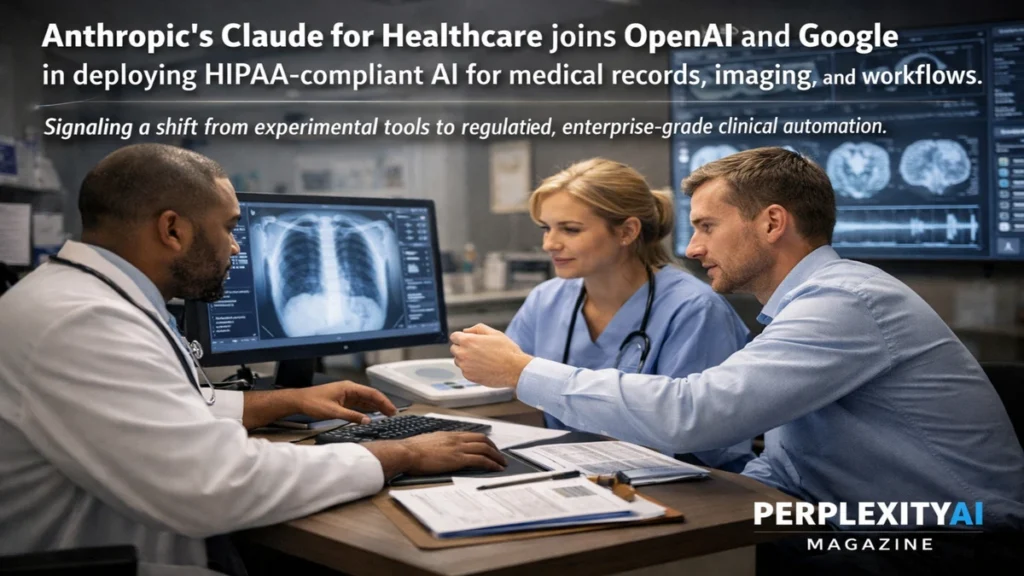
Artificial intelligence has reached a turning point in medicine, not through futuristic diagnostics alone, but through the less glamorous work of records, imaging checks, and administrative flow. In early 2026, Anthropic formally joined OpenAI and Google in this space with the launch of Claude for Healthcare, a HIPAA-compliant suite designed to summarize medical records, analyze images and scientific data, and automate clinical and payer workflows. The move places Anthropic alongside two of the most influential technology companies in the world as healthcare systems look for relief from documentation overload, staffing shortages, and rising costs. – AI for medical records and imaging.
In the first 100 words, the question most clinicians and administrators are asking is simple: how does this change daily work? The answer is incremental but meaningful. Claude, like OpenAI’s ChatGPT Health and Google’s MedLM and Vertex AI offerings, does not replace doctors or radiologists. Instead, it absorbs the cognitive and clerical load that increasingly dominates medical practice. These systems pull structured data from electronic health records, summarize encounters, flag anomalies in imaging, and prepare documentation for billing, prior authorizations, and appeals.
What differentiates the current wave from earlier experiments is maturity. All three companies emphasize HIPAA-compliant deployment, reduced hallucination rates, and tight integration with existing standards such as FHIR, ICD-10, and CMS databases. The competition is no longer about whether AI can help in healthcare, but where it fits best: front-line clinical work, backend administration, or imaging-intensive diagnostics. The convergence of Claude, OpenAI, and Google in this domain signals that AI in healthcare has entered its infrastructural phase.
The Healthcare AI Landscape in 2026
Healthcare has long been a proving ground for artificial intelligence, yet adoption has lagged behind promise. Early tools focused on narrow diagnostic tasks or research assistance, often disconnected from real-world clinical systems. By 2026, the landscape looks different. Providers and payers are under pressure to do more with less, and regulators have clarified expectations around privacy, auditability, and safety.
OpenAI, Google, and Anthropic now approach healthcare not as a single market but as an ecosystem of workflows. Medical records, imaging, billing, and research each demand different capabilities and tolerances for error. The result is specialization. OpenAI emphasizes clinician-facing tools that summarize notes and answer record-based questions conversationally. Google leans into multimodal diagnostics, applying large models to X-rays, MRIs, and pathology slides. Anthropic, with Claude for Healthcare, focuses on administrative and operational workflows where structure and compliance matter most.
An informatics director at a large hospital system summarized the shift: “We’re past pilots. Now we’re deciding which AI we trust for which job.”
Read: Anthropic Launches Claude Cowork Agentic AI Assistant
Claude for Healthcare: A Backend-First Strategy
Anthropic introduced Claude for Healthcare in January 2026 with a clear positioning: backend automation for regulated environments. Rather than targeting doctors directly, Claude is designed for administrators, payers, and clinical operations teams drowning in paperwork. The system integrates domain-specific connectors to FHIR standards, EHR systems, ICD-10 codes, the CMS Coverage Database, and PubMed for evidence retrieval.
At its core is Claude Opus 4.5, a model Anthropic says shows improved medical reasoning and lower hallucination rates. Claude’s agentic capabilities allow it to perform tasks such as prior authorization reviews, claims appeals, patient triage summaries, and protocol drafting. Each task produces auditable outputs, an essential requirement for regulated workflows.
Anthropic’s emphasis on structure is deliberate. By constraining the model through retrieval and schema validation, Claude reduces the risk of free-form errors. A healthcare compliance officer described the appeal: “In billing and authorization, creativity is a liability. Claude’s rigidity is a feature.”
OpenAI’s Clinician-Centered Approach
OpenAI’s recent ChatGPT Health reveal takes a different angle. The focus is on clinicians and patients interacting directly with records through conversational queries. Doctors can ask questions like “summarize this patient’s last three admissions” or “flag potential medication interactions,” with responses grounded in cited sources.
OpenAI also integrates data from wearables and personal devices, including phone and watch health metrics, to provide longitudinal context. This makes the tool attractive for front-line care and patient engagement. The trade-off is scope. Conversational flexibility is powerful, but it requires careful prompting and review. – AI for medical records and imaging.
A primary care physician who tested ChatGPT Health noted, “It’s like a very fast resident. Helpful, but you still double-check.”
Google’s Imaging and Multimodal Strength
Google’s healthcare AI strategy centers on imaging and multimodal analysis. Through MedLM, MedGemma, and Vertex AI, Google applies large models to radiology, pathology, and other image-heavy domains. These systems can analyze scans, detect anomalies, and assist with triage at scale.
Google’s strength lies in infrastructure. Vertex AI enables hospitals to fine-tune models on their own data within secure environments, a key requirement for large systems. Imaging labs and radiology groups, in particular, benefit from tools that reduce backlogs without compromising accuracy.
A radiologist involved in early trials said, “AI doesn’t replace reads, but it’s very good at catching what tired humans miss.”
Comparing the Three Approaches
| Platform | Primary Focus | Core Users | Strengths |
|---|---|---|---|
| Claude for Healthcare | Administrative workflows | Payers, admins | Compliance, structured ops |
| ChatGPT Health | Clinical interaction | Doctors, patients | Conversational summaries |
| Google MedLM / Vertex AI | Imaging diagnostics | Radiologists, labs | Multimodal precision |
| Capability | Claude | OpenAI | |
|---|---|---|---|
| Records summarization | Yes | Yes | Limited |
| Imaging analysis | Research-focused | Emerging | Core strength |
| Billing & prior auth | Core focus | Limited | Limited |
| Deployment model | Enterprise platforms | Individual workspaces | Cloud infrastructure |
Integration Through Standards, Not Shortcuts
A defining feature of Claude for Healthcare is its deep integration with existing healthcare standards. Claude uses FHIR-specific agent skills to generate and validate FHIR bundles directly from natural language prompts. These bundles adhere to HL7 FHIR R4 schemas, ensuring interoperability. – AI for medical records and imaging.
The Model Context Protocol server provides a standardized interface for CRUD operations on FHIR stores. Claude can query or update EHR data through platforms such as Google Cloud Healthcare API or AWS Bedrock. This architecture allows healthcare organizations to deploy AI without rewriting their systems.
OpenAI and Google also support FHIR, but Claude’s emphasis on schema validation and rules-based workflows reflects its administrative orientation. An EHR architect commented, “Claude feels like it was built by people who’ve lived inside FHIR specs.”
Imaging, Research, and Bioinformatics
While Claude is less imaging-centric than Google’s offerings, it does support analysis of scientific figures, proteins, and clinical images for research contexts. Anthropic has signaled partnerships in life sciences, including potential integrations with ClinicalTrials.gov and imaging platforms like Owkin. – AI for medical records and imaging.
This positions Claude as a bridge between operations and research. It can draft protocols, summarize trial criteria, and analyze datasets without leaving the enterprise environment. The distinction matters for pharmaceutical companies and academic centers where data governance is strict.
Deployment, Privacy, and Trust
All three companies emphasize HIPAA-compliant infrastructure, but their deployment models differ. Claude is delivered through enterprise platforms such as Microsoft Foundry, avoiding training on user data and focusing on de-identified access. OpenAI prioritizes individual and clinician workspaces with personal data syncs. Google integrates deeply with Vertex AI for large-scale hospital deployments.
Trust remains the central issue. Each system incorporates hallucination mitigation strategies, from structured retrieval to transparent sourcing and fine-tuned precision. None claim zero error rates. Instead, they position AI as an assistive layer requiring human oversight. – AI for medical records and imaging.
A medical ethicist observed, “The question is no longer whether AI will be used, but how openly its limits are acknowledged.”
Apple Health and Consumer Data Integration
Claude for Healthcare already includes Apple Health integration in beta, rolled out in January 2026 for Pro and Max subscribers in the United States. This allows users to sync fitness data, lab results, and medical history for personalized summaries and appointment preparation. A parallel rollout via Android Health Connect brings in data from Fitbit, Garmin, and Samsung Health. – AI for medical records and imaging.
This consumer-facing layer blurs the line between enterprise and personal health AI. It also raises questions about consent, data scope, and interpretation. Anthropic has emphasized that integrations are opt-in and sandboxed, but the expansion signals broader ambitions.
The Administrative Burden AI Aims to Lift
Much of healthcare’s burnout crisis stems from administrative overload. Prior authorizations, claims appeals, and billing checks consume hours that could be spent on care. Claude’s focus on these tasks reflects a pragmatic understanding of where AI can deliver immediate value.
By automating coverage checks against CMS databases and ICD-10 codes, Claude reduces manual review. Outputs are auditable, making them suitable for payer-provider interactions. This is not a flashy use case, but it is one with measurable impact.
A hospital CFO put it bluntly: “If AI can cut our denial rate by five percent, it pays for itself.”
Takeaways
- Anthropic, OpenAI, and Google now compete directly in healthcare AI.
- Claude for Healthcare focuses on administrative and payer workflows.
- OpenAI emphasizes clinician-facing summaries and conversational queries.
- Google leads in imaging and multimodal diagnostics.
- All three stress HIPAA compliance and hallucination mitigation.
- Integration with standards like FHIR is central to adoption.
Conclusion
The convergence of Claude, OpenAI, and Google in healthcare marks a shift from experimentation to infrastructure. AI is no longer a novelty layered onto medicine, but a set of tools embedded in its workflows. Each company has chosen a different entry point, reflecting both technical strengths and philosophical priorities.
Claude’s backend-first strategy highlights an often-overlooked truth: the future of healthcare AI may be decided as much by billing and records as by diagnosis. OpenAI’s conversational tools empower clinicians, while Google’s imaging models address scale and precision. Together, they form a mosaic of capabilities that, if deployed responsibly, could ease the system’s chronic strain.
The challenge ahead is not technical alone. Trust, governance, and clarity of role will determine whether these systems become indispensable or intrusive. For now, the quiet competition among Claude, OpenAI, and Google suggests that AI’s most important medical contributions may happen far from the bedside, in the data that surrounds it. – AI for medical records and imaging.
FAQs
What is Claude for Healthcare?
Claude for Healthcare is Anthropic’s HIPAA-compliant AI suite for medical records, billing, and administrative workflows.
How does it differ from ChatGPT Health?
Claude focuses on backend operations and payer tasks, while ChatGPT Health targets clinician-facing summaries and queries.
What is Google’s role in healthcare AI?
Google emphasizes imaging diagnostics and multimodal analysis through MedLM and Vertex AI.
Are these tools safe for patient data?
All three platforms emphasize HIPAA compliance, de-identified processing, and enterprise security controls.
Will AI replace clinicians?
No. These systems assist with documentation, analysis, and workflow, while clinicians retain decision-making authority.
