
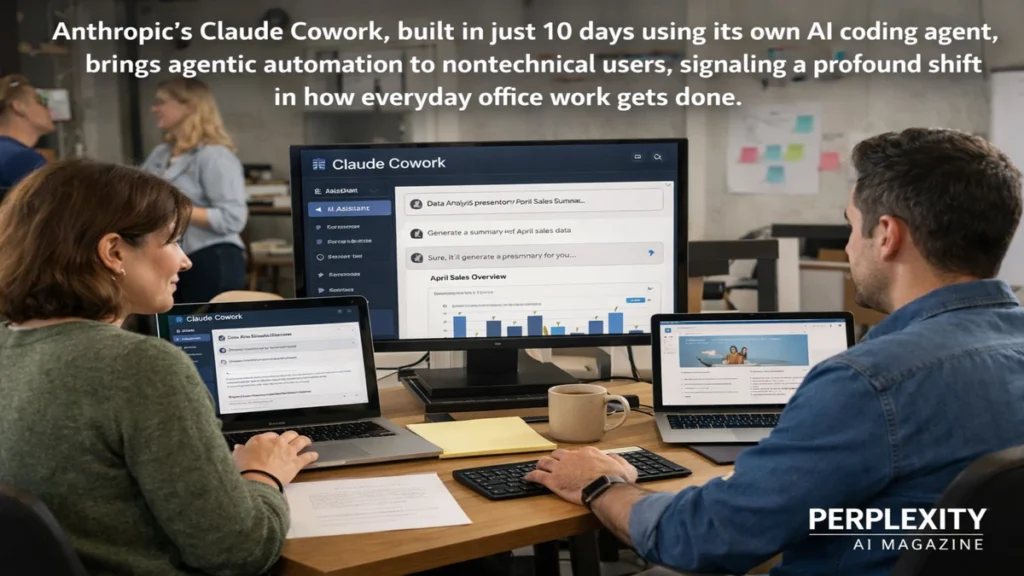
Anthropic’s launch of Claude Cowork, an agentic AI work assistant embedded in its desktop app, marks one of the clearest signals yet that artificial intelligence is moving beyond chat and into action. Released publicly on January 12, 2026, Claude Cowork allows everyday users to delegate real work—file organization, document creation, data analysis, and multi-step tasks—to an autonomous AI through plain-language instructions. The product matters not because it is flashy, but because of how it was built and who it is for.
Claude Cowork was developed in roughly ten days by Anthropic engineers using Claude Code, the company’s own AI coding agent. According to Anthropic, nearly all of Cowork’s production code was generated autonomously by Claude Code itself, guided by prompts and feedback rather than human-written software. The team began not with a product roadmap, but with observation: watching nontechnical users repurpose Claude Code for everyday tasks like vacation planning or recovering photos. From those behaviors, engineers stripped away the terminal interface and exposed agentic capabilities through a simple chat UI inside the Claude macOS app.
In the first 100 words, the reader’s intent is clear: what is Claude Cowork, how does it work, and why does it matter? Claude Cowork is an agentic AI assistant that can safely access local files, execute multi-step workflows, and coordinate parallel sub-agents, all without requiring users to write code. It matters because it compresses months of traditional software development into days and brings autonomous AI into the hands of office workers rather than engineers. In doing so, it offers a glimpse of a future where AI is less a conversational partner and more a quiet coworker.
From Claude Code to Claude Cowork
The origins of Claude Cowork lie inside Anthropic itself. Engineers noticed that nontechnical users were bending Claude Code—a developer-focused agent that runs code in a sandbox—to accomplish everyday tasks unrelated to programming. People asked it to plan trips, reorganize files, and reconstruct lost photos. Rather than dismissing these behaviors as misuse, the team treated them as product signals.
Led by Boris Cherny, head of Claude Code, the team prompted the AI to redesign its own interface. The terminal was removed. In its place appeared a chat-based workflow designed for clarity, permissioning, and trust. Claude Code was instructed to design and implement features such as file system access, task queuing, and sandboxed execution, drawing on Anthropic’s Agent SDK for core behaviors like parallel task execution and connector management.
Claude Code handled iterative development inside a virtual machine built using Apple’s VZVirtualMachine framework, booting a custom Linux environment to safely interact with local files and browsers. Feedback loops were tight. Engineers reviewed outputs, refined prompts, and let the agent rework the system. Anthropic has said no human-authored production code was required, underscoring how agentic AI can now function as a software builder, not just an assistant.
Read: NLPearl AI Pearl: Autonomous Voice Agents for Call Centers
What Makes Claude Cowork Agentic
Claude Cowork differs from traditional AI assistants in one crucial way: it acts. Instead of answering questions or drafting text alone, it executes tasks autonomously across multiple steps. A single instruction like “Organize my receipts by date and create a spreadsheet summary” can trigger file access, data extraction, spreadsheet generation, and cleanup, all handled by the agent.
This agentic behavior is enabled by pre-existing components in Anthropic’s Agent SDK. These include native task planning, sub-agent coordination, and connectors for external services. Cowork can queue long-running tasks, report progress in real time, and resume work if interrupted. It can also split complex requests into parallel streams, such as analyzing data while drafting a report.
An AI systems researcher described the shift succinctly: “We’re moving from assistants that talk about work to agents that do work.”
Claude Cowork’s autonomy is bounded by permissions. Users must explicitly grant folder access and approve proposed plans before execution. This balance—agency with consent—is central to Anthropic’s design philosophy and differentiates Cowork from background automation tools that operate invisibly.
File Management as a First-Class Use Case
One of Claude Cowork’s most immediate applications is file management, a task that consumes countless hours of office labor. Once granted access to a folder, Cowork can read, edit, rename, organize, or create files based on natural language instructions. Users can ask it to clean a cluttered desktop, sort downloads by type and date, or batch-rename files with consistent prefixes.
These actions occur inside a secure virtual machine sandbox. Cowork proposes a plan, waits for approval, and then executes. If something goes wrong, users can intervene mid-process or roll back changes. The design reflects an understanding that trust is earned through transparency.
For knowledge workers, this capability eliminates low-value work that often gets deferred or ignored. An operations manager at a mid-sized firm noted, “It’s not glamorous, but file hygiene matters. Having an AI handle it reliably is a relief.”
Document Creation Without Setup
Claude Cowork’s document generation capabilities extend beyond simple drafting. The agent can produce Excel spreadsheets complete with formulas such as VLOOKUPs and conditional formatting, generate PowerPoint presentations from rough notes, and assemble polished reports from fragmented inputs like screenshots or voice memos.
Unlike traditional office automation tools, Cowork does not require templates or manual configuration. Users describe the outcome they want, review the proposed steps, and let the agent execute. This approach lowers the barrier for sophisticated outputs, especially for users who lack advanced spreadsheet or presentation skills.
The implications are significant for small teams and individuals. Tasks that once required specialized knowledge can now be delegated to an AI agent, freeing humans to focus on judgment and strategy rather than mechanics.
Local Data Analysis for Non-Experts
Data analysis has long been a bottleneck for nontechnical users. Claude Cowork addresses this by allowing users to run statistical analyses on local files without writing code. The agent can clean datasets, detect outliers, perform time-series analysis, and generate visualizations, all through conversational prompts.
Because analysis runs within the sandboxed environment, sensitive data remains local. Results are presented as transformed files or charts that users can inspect and reuse. This model bridges a gap between powerful analytics tools and everyday office needs.
A data science educator commented, “This doesn’t replace analysts, but it dramatically raises the floor for what non-analysts can do.”
Task Execution and Parallel Work
Claude Cowork supports long-running, multi-step workflows that unfold over time. Users can start a task, step away, and return to find progress updates or completion summaries. Sub-agents coordinate parallel workstreams, such as researching information while preparing documents.
Integration with connectors expands Cowork’s reach. Through tools like Asana or Notion, and browser tasks via Claude in Chrome, the agent can interact with web-based systems as part of its workflow. This orchestration turns Cowork into a lightweight operations layer rather than a single-purpose tool.
Getting Started With Claude Cowork
Claude Cowork requires the Claude Desktop app for macOS and a Pro or Max subscription, priced between $20 and $200 per month. Users download the app from Anthropic’s website, log in, and switch from “Chat” to the “Cowork” mode in the sidebar.
Initial setup emphasizes safety. Users grant folder permissions selectively, often starting with a dedicated test folder. Tasks begin with natural language descriptions. Cowork proposes a plan, which users approve before execution. The app must remain open during tasks, and users can intervene at any point.
This deliberate onboarding reflects Anthropic’s caution. The goal is not silent automation, but collaborative autonomy.
How Claude Cowork Compares to Traditional Assistants
| Dimension | Traditional AI Assistant | Claude Cowork |
|---|---|---|
| Core function | Responds, drafts | Executes tasks |
| File access | Limited or none | Explicit, sandboxed |
| Multi-step workflows | Manual | Autonomous |
| Target user | General | Knowledge workers |
| Setup complexity | Low | Low, with permissions |
| Development Aspect | Conventional Software | Claude Cowork |
|---|---|---|
| Build time | Months | ~10 days |
| Code authorship | Human engineers | AI-generated |
| Iteration cycle | Slow | Rapid feedback loops |
Expert Perspectives on Agentic Work Assistants
Industry observers see Claude Cowork as a milestone, but not a finish line. A human-computer interaction researcher noted, “The challenge isn’t capability anymore. It’s designing interfaces that let people feel in control.”
A software engineering professor added, “The fact that the tool built itself is remarkable, but governance and testing will matter more as these systems spread.”
An enterprise IT leader was pragmatic: “If it saves my team hours without breaking things, it’ll stick.”
Takeaways
- Claude Cowork was built in about 10 days using Anthropic’s own AI coding agent.
- Nearly all production code was generated autonomously by Claude Code.
- The tool brings agentic AI to nontechnical users through a chat interface.
- Core features include file management, document creation, and data analysis.
- Tasks run in a secure virtual machine with explicit user permissions.
- Claude Cowork signals a shift from conversational AI to actionable AI.
Conclusion
Claude Cowork is less a product launch than a quiet redefinition of work. By collapsing the distance between intent and execution, Anthropic has shown how agentic AI can move from labs and developer tools into everyday office life. The speed of its creation, powered largely by AI itself, hints at how software development may evolve when agents can design, build, and refine products in days.
Yet the significance of Claude Cowork lies not in its novelty, but in its restraint. Permissions are explicit. Plans are reviewable. Autonomy is earned, not assumed. In a field often driven by maximal claims, Cowork advances through modest confidence.
If this model holds, the future of AI at work may look less like replacement and more like redistribution—machines handling the mechanical, humans focusing on meaning. Claude Cowork is an early step down that path.
FAQs
What is Claude Cowork?
Claude Cowork is an agentic AI work assistant in Anthropic’s Claude Desktop app that can autonomously execute office tasks.
How was Claude Cowork built so quickly?
It was developed in about 10 days using Claude Code, Anthropic’s AI coding agent, which generated most of the code.
Who can use Claude Cowork?
It is designed for nontechnical knowledge workers using macOS with a Pro or Max Claude subscription.
Is my data safe with Claude Cowork?
Tasks run in a sandboxed virtual machine, and users must explicitly grant folder access.
Does Claude Cowork replace human workers?
No. It automates routine tasks, allowing humans to focus on judgment and creative work.
